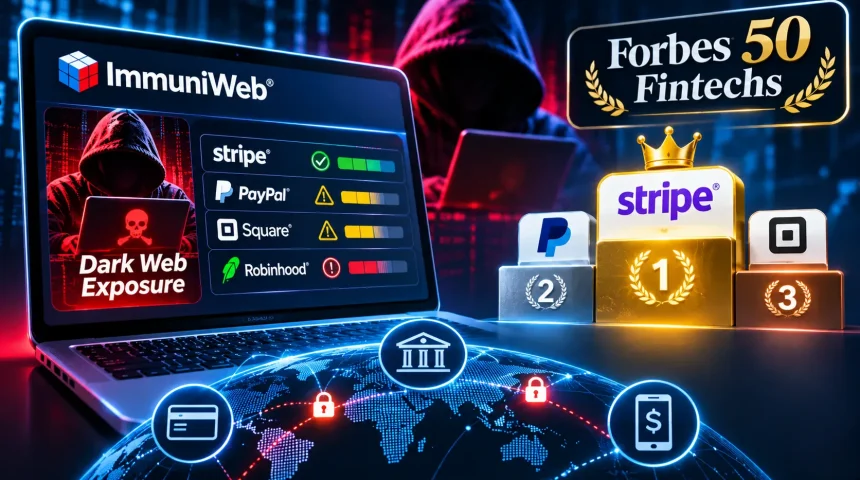
ImmuniWeb’s CyberScore platform now features a table for 49 companies from the Forbes Fintech 50. Each company gets a grade from A+ to F in five areas: website security, privacy, encryption, email security, and GenAI exposure. Dark web exposure is shown separately with incident details. Stripe, Reserv, and Lead Bank earned the highest A grades. The tool relies on public scans and dark web intelligence, and you can access full technical reports for free by registering an account.
What the Tool Actually Measures
CyberScore looks at six categories. Five of them get letter grades from A+ to F. Dark web exposure is handled differently and needs a separate explanation.
For the graded categories, ImmuniWeb uses a non-intrusive method. It scans only what is publicly accessible, without needing credentials or internal access. This shows what an attacker could find from the outside. Email security checks look at whether the company has set up SPF, DKIM, and DMARC records correctly. These settings help prevent someone from spoofing a fintech’s email domain and sending fake messages. Weak email security is a major reason for business email compromise, which cost the financial sector billions in 2025.
The GenAI exposure category is new and shows how quickly risks are changing. Many financial services firms have added AI tools to their operations, sometimes exposing endpoints, models, or data pipelines to outside access. ImmuniWeb’s scan checks how much of this exposure can be seen from the public internet. This kind of measurement was not a standard metric two years ago.
Dark web exposure does not get a letter grade because that would be misleading. Data on the dark web is more of a yes-or-no issue, either credentials from your domain are being traded in criminal markets, or they are not. ImmuniWeb shows this category with incident breakdowns and risk indicators, giving details about what was found, when it was found, and what it means for the organization’s risk.
This connects directly to the pattern we’ve documented throughout 2026: dark web signals often appear weeks or months before an organization realizes it has a problem. The Australian Medicare listing, the Substack credentials, the SFR customer records- in every case, dark web intelligence surfaced the exposure before official disclosure. Having that signal built into a vendor’s public score changes the procurement conversation.
Who Scored Well and Why It Matters
Stripe, Reserv, and Lead Bank achieved the highest distinction, A grades, in the initial batch of rated fintechs. Cardless, Mercury, Polymarket, and Justt each received A- grades.
It’s not surprising that Stripe is at the top. The company has always invested a lot in security engineering. The smaller companies on the list are also important to mention. Reserv and Lead Bank are not widely known outside of fintech, but their strong scores prove what ImmuniWeb’s CEO, Dr. Ilia Kolochenko, said: “The strong grades achieved by Stripe, Reserv and Lead Bank show that a high standard of security is achievable.”
For companies that did not score as well, the results are more concerning. These are not hidden issues. Any determined attacker could find things like misconfigured email authentication, unpatched public-facing systems, or exposed credentials in breach databases. If a tool can find them through public scans, attackers can too.
The SilentRansomGroup’s campaign against six law firms in a single month was partly successful because those firms had predictable external vulnerabilities. The same logic applies to fintechs. High-profile breaches at vendors have already cascaded into consequences for JPMorgan Chase, Visa, and Mastercard. The weak link isn’t always the giant.
The Third-Party Risk Problem This Is Designed to Fix
Financial services companies face risks not only from their own systems but also from every vendor they rely on. Payment processors, identity verification services, cloud providers, and compliance tools are all part of the fintech ecosystem. Each one is a possible entry point for attackers.
The CyberScore expansion specifically targets this. Dr. Kolochenko was direct about it: “Their risk also extends well beyond their own perimeter, to the vendors and partners they depend on.”
Traditional third-party risk management uses questionnaires, audits, certifications, SOC 2 reports, ISO 27001 attestations, and security assessments that vendors complete themselves. Security professionals call this a “black box” problem because you have to trust the vendor’s own assessment. CyberScore does things differently by measuring what is visible from the outside, without needing any input from the vendor.
Procurement teams looking at a new payments partner or identity verification vendor can now check that partner’s external security score, including dark web exposure, before signing a contract. This changes the due diligence process. As the dark web intelligence market grows by more than 21% each year, tools that provide this information without needing a full threat intelligence program are meeting a real need.
The UK Finance Sector Context
The timing of this expansion is not random. At the time of the announcement, cyber incidents in the UK finance sector hit their second-highest monthly level in five years. This number comes from regulatory and industry monitoring, not just stories about breaches, and shows a steady rise in incidents.
The CRIF Cyber Observatory’s H1 2026 data showed 2.5 billion records circulating on the dark web in just the first six months of the year, with financial services credentials among the most traded data types. What ImmuniWeb is surfacing through CyberScore is the visible portion of a much larger problem.
At Fintech Connect 2026, where ImmuniWeb announced the expansion, compliance and security leaders from the sector gathered as regulators focused more on vendor risk management. Because CyberScore ratings are public, they create accountability that internal audits cannot match. Anyone—regulator, partner, or journalist—can check a company’s score without needing to ask.
What “Free” Means Here
You can see headline grades without registering; just look up a company’s score on ImmuniWeb’s platform. If you register for a free account, you get access to full technical reports, PDF assessments, and can track changes over time. There is no paid tier needed to use the fintech industry table.
This matters because it removes the barrier that keeps security transparency tools in enterprise sales cycles rather than in the hands of teams that actually need them. A startup evaluating a potential banking partner doesn’t have a procurement department running a full vendor assessment; a free public score with a technical breakdown levels that playing field somewhat.
Frequently Asked Questions
What is ImmuniWeb CyberScore?
A cybersecurity rating platform that assigns letter grades to companies based on external, non-intrusive scans across website security, privacy, encryption, email security, GenAI exposure, and dark web exposure.
Which fintechs scored highest?
Stripe, Reserv, and Lead Bank achieved A grades. Cardless, Mercury, Polymarket, and Justt received A- grades.
What does the dark web exposure category show?
Unlike the other five categories, dark web exposure isn’t graded A-F. Instead, it shows specific incidents and risk indicators, such as credentials from a company’s domain circulating in criminal markets.
Is CyberScore free to use?
Yes. Headline grades are publicly available without an account. Free registration unlocks full technical reports and PDF assessments.
Why does fintech security matter beyond the company itself?
Fintechs are deeply interconnected. A breach at a fintech vendor has cascaded into consequences for major institutions, including JPMorgan Chase, Visa, and Mastercard. Third-party risk is inseparable from internal risk in modern financial services.