Before a hack becomes a headline, it usually starts as something much smaller and much quieter: a post on an underground forum offering to sell access to a developer’s account, or a batch of stolen login keys nobody’s using yet. By the time it turns into a company’s official breach announcement, researchers may have already been watching it happen for weeks.
That’s the core idea behind a recent investigation into underground forums, and 2026 handed us a real-world example that proves the point almost too well. A single hacked security tool in March quietly grew into breaches at Cisco, the European Commission, and a company that supplies data behind live sports betting. And that’s not even the biggest supply-chain story of the year. That one came from a worm that spreads itself, and by August it had wormed its way into code downloaded over a billion times a month.
Here’s what a supply-chain attack actually is, why the dark web tends to see it coming first, and why any of this matters even if you’ve never written a line of code.
Quick answer: A supply-chain attack targets a tool, vendor, or piece of shared code a company depends on, rather than attacking the company directly. Warning signs, like stolen developer access or leaked source code, often surface on dark web forums weeks or months before an attack becomes public. Two real 2026 cases show exactly how that plays out: a hacked open-source scanner that led to breaches at Cisco and the European Commission, and a self-spreading worm that infected code used by over a billion downloads a month.
What Is a Supply-Chain Attack
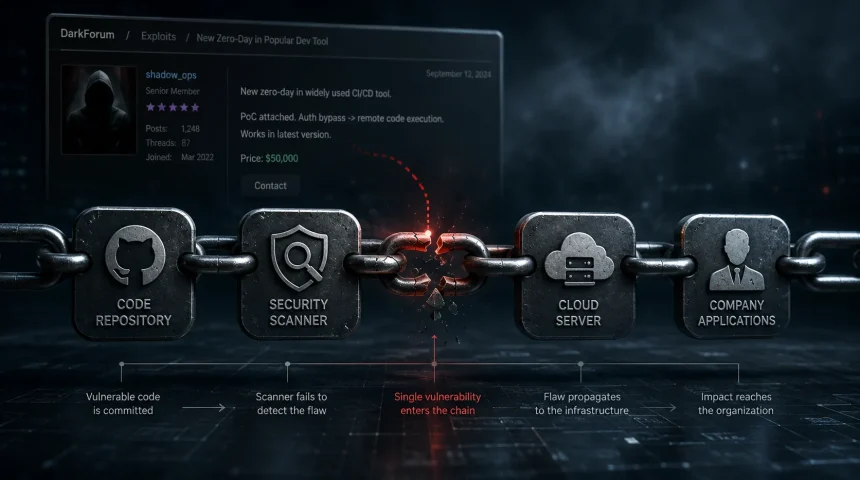
Most hacks go after one company directly. A supply-chain attack goes after something that a company depends on instead: a tool it uses, a piece of free code its software is built on, or a vendor with trusted access into its systems.
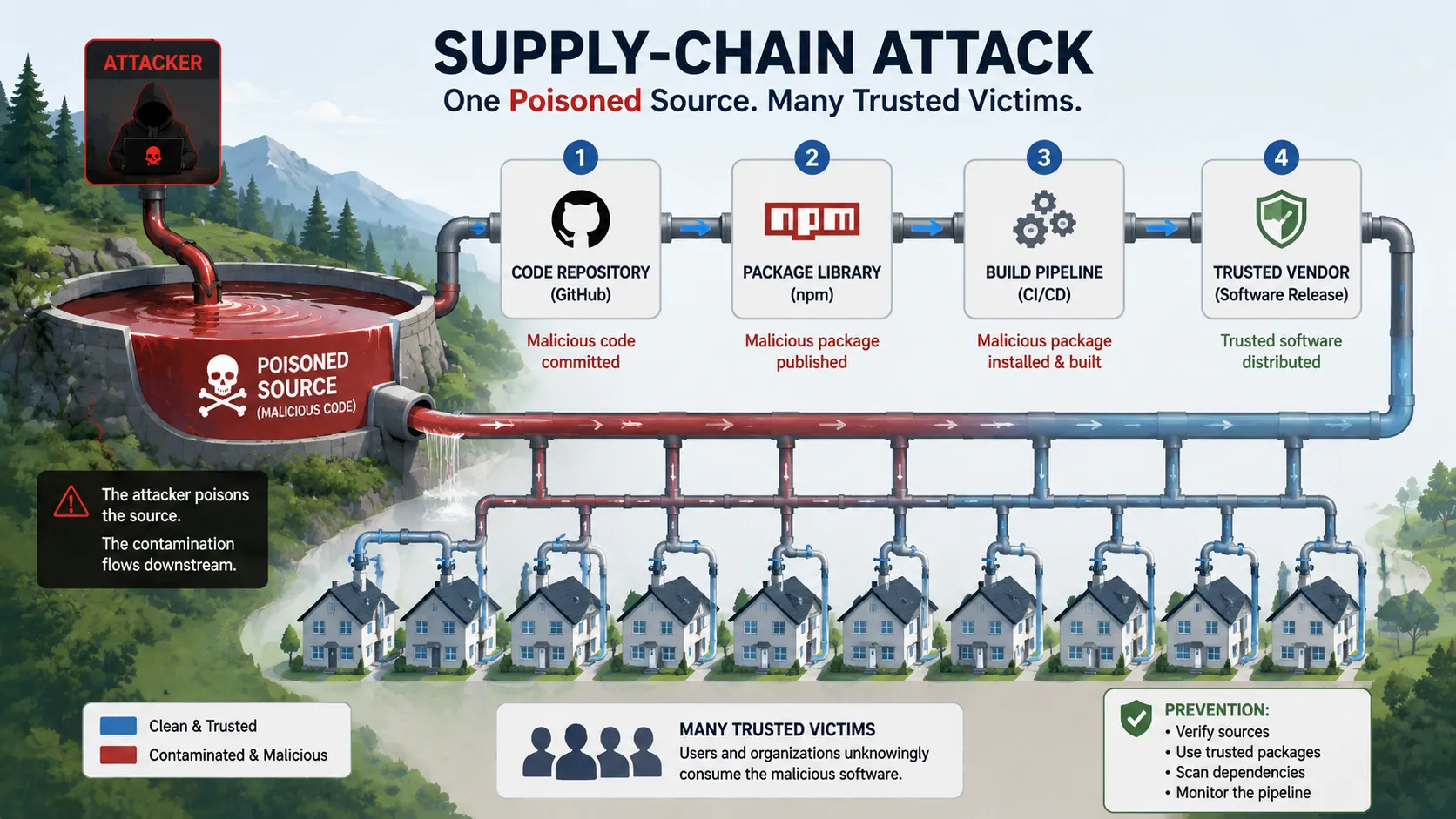
Think of it like poisoning a water supply instead of one house. Contaminate the reservoir, and it doesn’t matter how good any single house’s plumbing is. Everyone downstream drinks the same water.
In software, that “reservoir” is usually one of these:
- A code repository: A storage site like GitHub, where developers keep and share the code their software runs on.
- A package library: Like npm or PyPI, where developers pull in small, pre-written chunks of free code instead of writing everything from scratch.
- A build pipeline (CI/CD): The automated system that takes raw code and turns it into the finished app or update you actually install.
- A vendor’s own systems: When that vendor has trusted access into a company’s internal tools.
Compromise any one of those, and an attacker can potentially reach every company and every user downstream, all through something that looked completely legitimate.
Why the Dark Web Sees It First
Attackers don’t post “planning a supply-chain attack” on a forum. What actually shows up first is far more mundane: someone selling GitHub access, a leaked private repository, a batch of stolen API keys, or login tokens for a company’s cloud accounts.
On its own, a post like that can look like routine cybercrime chatter. The real risk isn’t the post itself, it’s what that access touches. A stolen developer account might lead nowhere. Or it might sit inside the exact tool a thousand other companies quietly depend on.
Researchers at the dark web monitoring firm Flare recently walked through several real examples of this pattern in a report published through BleepingComputer. 2026 has already handed us two textbook cases of quiet underground chatter turning into full industry incidents.
Case One: A Security Scanner Became the Weapon
In March 2026, attackers identifying as TeamPCP broke into the build pipeline behind Trivy, a widely used open-source scanner that companies run specifically to catch security problems in their own software. The irony wasn’t lost on anyone: the tool meant to catch vulnerabilities became one.
TeamPCP tampered with Trivy’s code and its connected GitHub Actions, small automated scripts that plug into a company’s build process. That meant companies simply using Trivy the way it’s meant to be used, like trusting a routine antivirus scan, ended up running compromised code instead, tracked publicly as CVE-2026-33634.
From there, it spread outward. Stolen credentials from the Trivy compromise were later used to breach Cisco’s internal development systems. The European Commission confirmed its own cloud hosting platform had been breached through the same compromise, with roughly 340 GB of data taken across dozens of hosted client organizations. Sportradar, a company that supplies real-time data behind sports betting and broadcasts for major leagues, confirmed what researchers called a systemic compromise, with hundreds of API key pairs exposed, putting Sportradar’s own partners at secondary risk too. TeamPCP has since been linked to further activity, including claims of stolen source code from AI company Mistral, which Mistral has partly disputed.
None of this started with a dramatic breach announcement. It started with access to one open-source tool’s build pipeline, and pieces of it were reportedly visible on underground forums weeks before most public reporting caught up.
Case Two: The Worm That Spreads Through Trust Itself
The second story is arguably scarier, because no human attacker needs to keep pulling the trigger once it starts.
Back in September 2025, a self-spreading worm nicknamed Shai-Hulud, after the giant sandworms in the novel Dune, began working its way through npm, the library millions of developers pull free code from. Once it compromised one developer’s account, it automatically stole their credentials, injected itself into every other package that developer maintained, and published the infected versions straight back to the public library. No human attacker had to do anything for each new step.
It went quiet for a while, then came roaring back. On August 4, 2026, a more advanced version, which Microsoft’s threat intelligence team named CHAINDROP, hit a single widely used code library called keyv. Because so many other packages depend on keyv, the infection spread to more than 400 separate packages within hours, reaching software with a combined total of over a billion downloads a month.
Nobody using that affected software did anything wrong. They installed an ordinary, everyday update to a tool they already trusted, the same way you’d accept an app update on your phone without a second thought.
Why This Actually Matters to You
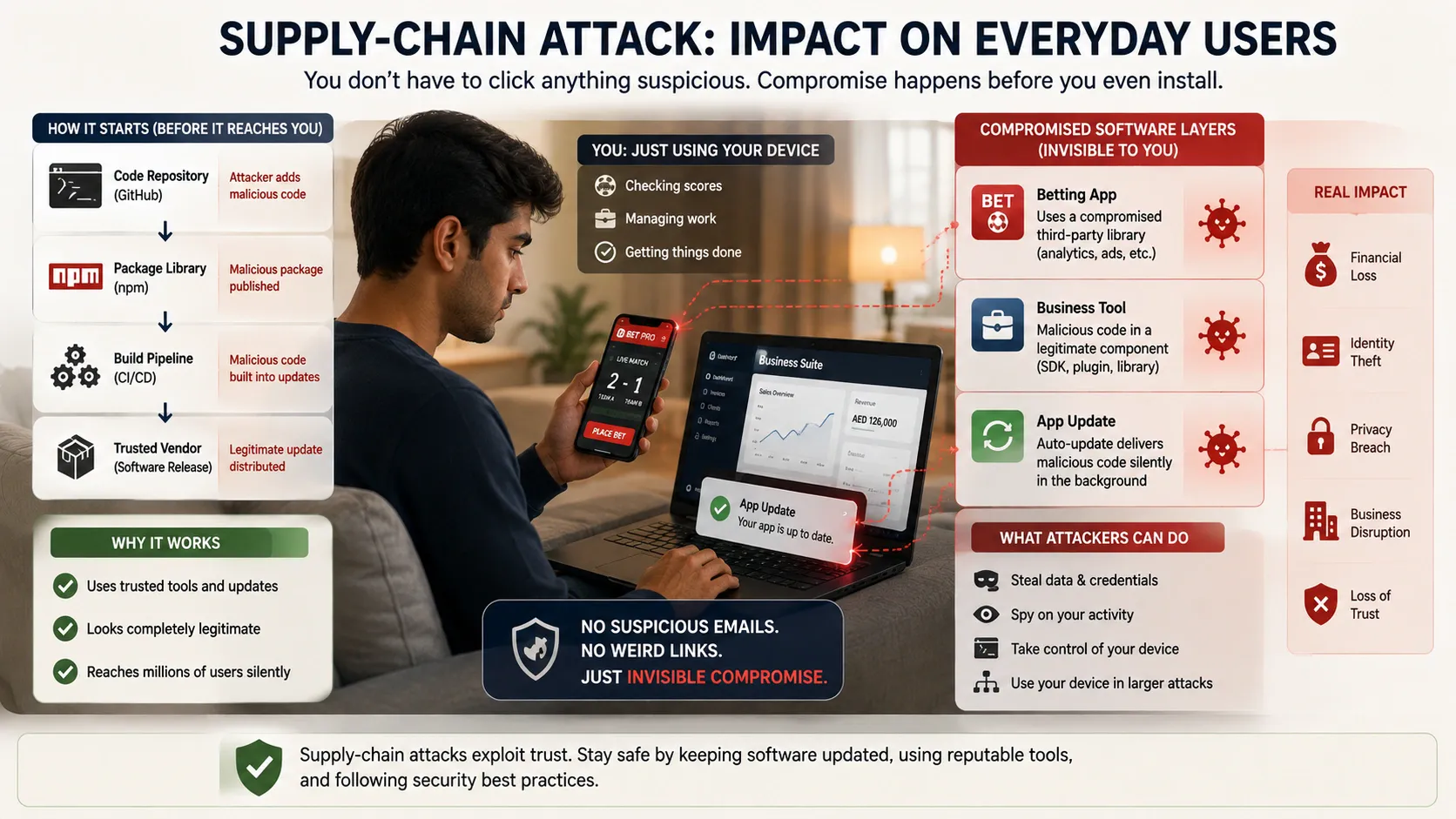
You’ve probably never heard of Trivy, npm, or keyv, and that’s exactly the point. These are the invisible plumbing behind software you do use every day. A breach at a company like Sportradar can ripple into the odds displayed on a betting app. A compromised code library can quietly ride along inside a business tool, a website, or an app update most people install without a second thought.
The uncomfortable thread running through both cases is the same: trust is the actual target. Attackers increasingly aren’t trying to break down anyone’s front door. They’re trying to get invited in through a door that’s already trusted.
What You Can Actually Do
If you run a small business or handle IT for one, the takeaway isn’t “start monitoring the dark web yourself,” most people don’t have the tools or time for that. It comes down to a few practical habits instead:
- Keep software updated, but pair it with basic monitoring. An update is usually safe, but 2026 proved it can occasionally be the attack itself.
- Turn on multi-factor authentication everywhere it’s offered, especially for anything tied to code, cloud accounts, or developer tools. Stolen credentials sat behind a large share of this year’s incidents.
- Pay attention to vendor breach notifications. If a tool or service you rely on discloses an incident, don’t assume you’re in the clear just because you weren’t hacked directly.
- If your business relies on third-party vendors with system access, ask what that access actually covers, and whether it’s limited to only what they genuinely need.
For everyday users, there’s less to actively do, but it’s worth knowing that “I didn’t click anything suspicious” doesn’t fully cover you anymore. Some of 2026’s biggest incidents started with a completely legitimate-looking update to a tool nobody thought twice about.
Frequently Asked Questions
What is a supply-chain attack?
An attack that targets a trusted vendor, tool, or piece of shared code a company depends on, instead of attacking the company directly.
Why do supply-chain attacks show up on the dark web before the news?
Because the access that enables them, stolen developer accounts, leaked code, exposed keys, is often sold or discussed on underground forums well before anyone realizes what it will be used for.
What was the Trivy attack?
A March 2026 compromise of the build pipeline behind Trivy, a popular open-source security scanner, carried out by a group tracked as TeamPCP. It led to further breaches at Cisco, the European Commission, and Sportradar.
What is Shai-Hulud?
A self-spreading worm targeting npm, the open-source code library millions of developers use. It steals a developer’s credentials and automatically infects every other package they maintain, spreading without further action from the attacker.
Am I affected if I don’t work in tech?
Possibly, indirectly. These attacks target the software running behind everyday apps, websites, and services, so you can be affected without installing anything yourself.