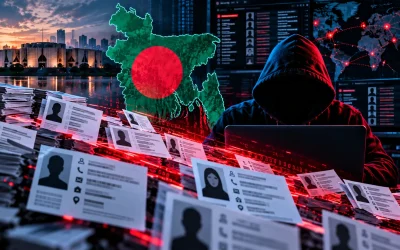
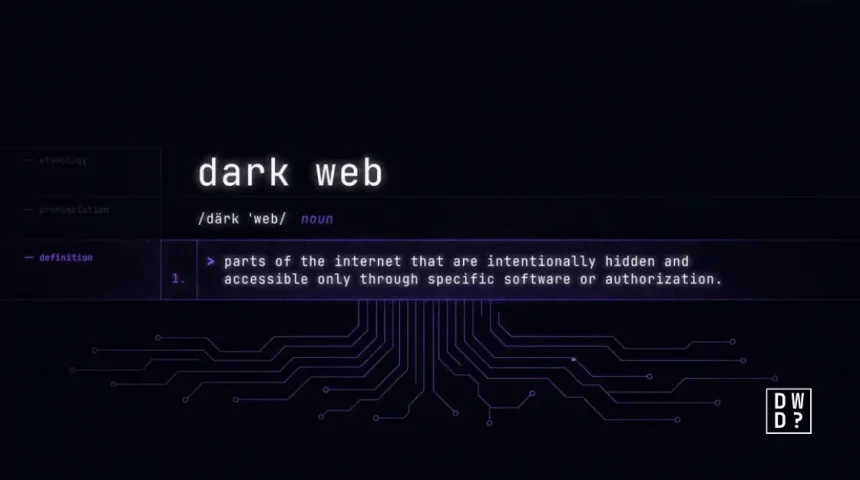
Dark Web Meaning: There is a common misconception about the layers of the internet. It is believed that the dark web is essentially bad because it is frequently associated with cybercrime, illicit marketplaces, and anonymous activities. But the truth is that not all of its contents are illegal or against the law.
The dark web can be a crucial tool for journalists, whistleblowers, activists, and privacy advocates, among many others. They utilise this layer of the internet to perform legal tasks and operations while keeping their identities anonymous.
For example, journalists may use the dark web to contact whistleblowers in order to obtain information while hiding their identities. On the other hand, activists can use the platform to speak out or campaign for social, political, or environmental changes.
In general, the dark web isn’t just a criminal ecosystem. It is the bottom of the three layers of the internet, a hidden space where people can communicate, trade and share information without revealing their identity.
Nevertheless, in this guide, we will be providing everything you need to know about the dark web. This guide will explain what the dark web is, how it functions, what’s actually on it and its legal status by country. We’ll also go over the dangers of using the dark web, typical frauds and online dangers, precautionary tips, and debunk some of the myths surrounding the dark web. Here’s where we start.
Dark Web Explained ~ Overview
The dark web is the anonymous layer of the internet that lies at the bottom of the deep web, and occupies only a tiny portion of it. The majority of people will never come into contact with it because it is most obscure, and not all browsers support anonymity.
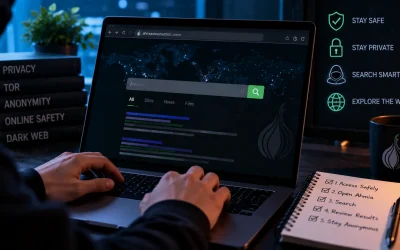
Simply put, the dark web is a concealed area of the internet that is inaccessible via conventional browsers like Chrome, Opera and Firefox. Its content is not indexed by search engines like Google, which makes it not easily accessible. Reaching it takes purpose-built software instead. The most common is the Tor Browser, which is currently the only client that resolves the .onion domain. Once you are on the network, onion search engines such as Ahmia do the indexing work Google cannot.
The dark web has useful applications even though it is frequently linked to cybercriminals. Activists, journalists, and privacy advocates may use it for safe communication and information access in confined spaces.
However, others may exploit it for unlawful acts like selling narcotics or stolen data. Due to its involvement in threat intelligence, cybercrime, and data leaks, the dark web continues to play a significant role in cybersecurity, despite comprising only a small portion of the internet.
History Of The Dark Web ~ How It All Started!
The history of the dark web started as an advanced research project in the late 20th century, with the influence of the U.S. federal government. We cover this in more depth in our breakdown of who created the dark web, but the short version matters here. Note that the internet was first developed as a decentralised system to aid military troops, researchers, organisations and ordinary individuals. But during its early days of invention, sharing information over distances was the main aim; privacy was not the top priority.
As the internet grew, the need for safe and anonymous communication became a necessity. Users, especially the military troops, needed a mechanism to keep their identities and actions private due to the emergence of repressive regimes, censorship, and surveillance. That was when the idea of the dark web began to take shape.
Researchers and privacy activists started experimenting with anonymising technology that would shield users’ identities. In 1995, scientists Paul Syverson, David Goldschlag, and Michael Reed invented onion routing at the U.S. Naval Research Laboratory. By enabling anonymous communication, onion routing was developed to safeguard members of the intelligence community.
Additionally, it protected whistleblowers, gave individuals and journalists living under repressive regimes the right to think and express themselves, and kept others safe by preserving their anonymity. The Navy patented onion routing in 1998, and DARPA (Defence Advanced Research Projects Agency) funded much of the development through those early years.
After the patent, computer scientists Roger Dingledine and Nick Mathewson joined Syverson to build the largest onion routing project to date. The network went live on 20 September 2002 as The Onion Routing project, shortened to Tor, and its code was released under a free and open licence from the outset. The Naval Research Laboratory released the Tor code under a free licence in 2004, the same year the Electronic Frontier Foundation began funding Dingledine and Mathewson’s work. The nonprofit that runs it today, The Tor Project, Inc., wasn’t founded until 2006. The Tor Project’s own history page lays out the sequence.
Numerous branches of the US government, including the Department of Defence, as well as the governments of other developed nations, human rights organisations, and numerous others, have sponsored the Tor Project in the past and present. These sponsors support the Tor Project because they think it protects democratic activists in autocratic regimes.
That support has shrunk, though, and the numbers are worth knowing if anyone tells you Tor is a government front. US government grants made up 53.5% of Tor’s revenue in the 2021–2022 financial year and just over 35% by 2023–2024, with the State Department’s Bureau of Democracy, Human Rights and Labor the largest single contributor at $2.12 million. One of the remaining channels closed in March 2025, when an executive order dismantling the US Agency for Global Media cut off the Open Technology Fund.
How the Dark Web Operates
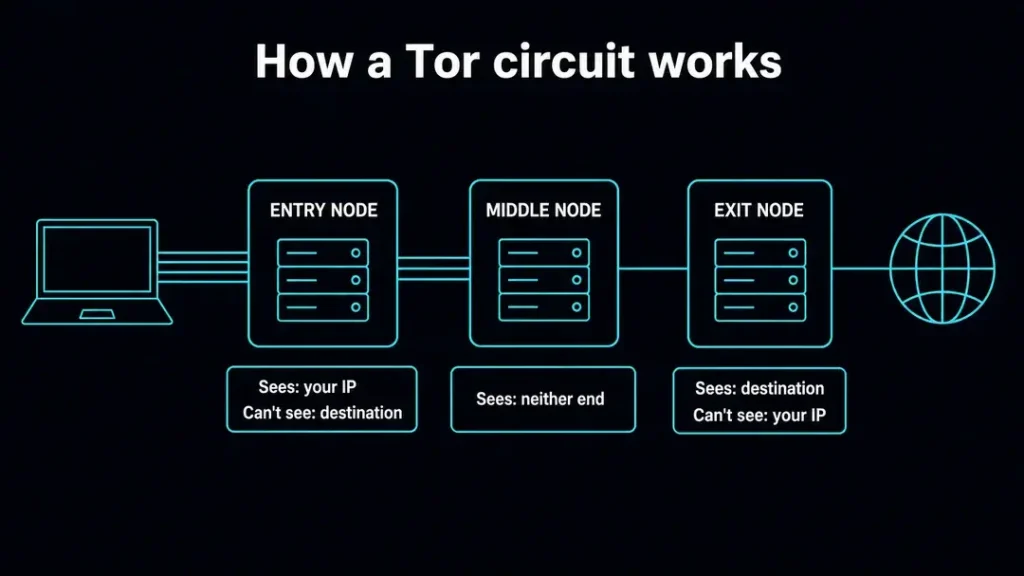
The .onion addresses used by dark websites are exclusive to the Onion Router (Tor). Tor is a network of volunteer-run servers, referred to as nodes or relays, that collaborate to conceal internet activities. There are currently somewhere in the region of 8,000 to 9,000 of them.
With the Tor browser, your data doesn’t go directly when you access a dark web site. Rather, data is transmitted over a chain of at least three relays and covered in multiple layers of encryption. This is a simplified version of the sequence of events:
Entry node: Although this initial server can see your IP address, it is unaware of the destination of your traffic. All it does is forward it to the middle node.
Middle node: This server transmits the encrypted data without being aware of its original source or final destination. The data is sent to the exit node.
Exit node: Your data is sent to its destination once this last server decrypts the final layer of encryption. It can only determine that it originated from the middle node.
The layered design has the benefit of preventing any one node from ever knowing the whole picture. It is comparable to mailing a package in multiple boxes, each with a distinct destination. Relays never see the whole path; they merely open the outermost box and forward the subsequent one. If you want to see this in practice, our guide on how to access the dark web safely walks through the setup end to end.
The Tor Architecture: A Detailed Review
Tor is the second-generation anonymous communication protocol based on onion routing. It is a vast and complex project that was introduced as “a circuit-based low-latency anonymous communication service.” It was designed with the aim of improving communication without sacrificing privacy.
The network is not the same as HTTPS, where clients are visible to observers, but the contents are encrypted. In order to offer anonymity, the browser jumps users across several channels or servers called nodes.
What it does not do is defend against an attacker who can watch the entire network at once. The Tor design paper says so plainly: like every practical low-latency system, Tor does not protect against a global passive adversary. It assumes an opponent who can observe a fraction of network traffic, run some relays, and compromise some others. Anyone who tells you Tor beats a nation-state watching every link is selling something.
The Tor browser can be downloaded by anyone with a personal computer, and anyone can choose to offer their computer as a network node. A user’s machine becomes an Onion Proxy when they install the Tor browser.
Tor circuits enable cell communication between nodes without disclosing any more information beyond the sender and recipient of the message. All nodes are connected to one another via TLS connections, and every node has a specific role in receiving and transmitting data from one node to the next; no information is disclosed until the data reaches its destination.
Because circuits are designed to process many TCP requests simultaneously, the network is more efficient, and the possibility of reidentification based on circuit uniqueness is reduced. Each circuit’s end will retrieve the required data from a web host and send it back through the circuit.
This circuit is similar to taking a different route every time you walk to and from your favourite store in town. One of the key differences between earlier iterations of low-latency anonymity networks is the construction of circuits.
Before sending traffic to the server’s host, the Pluggable Transport (PT) Client software on the client’s host exposes a SOCKS proxy to the client application and modifies it. The PT Server software on the server’s host offers a reverse proxy that takes connections from PT Clients and reverses the obfuscation or transformation made to the traffic before sending it to the server software itself. This is the machinery that lets people in censored countries connect at all, and it is why bridges work when the main network is blocked.
What The Dark Web Actually Contains
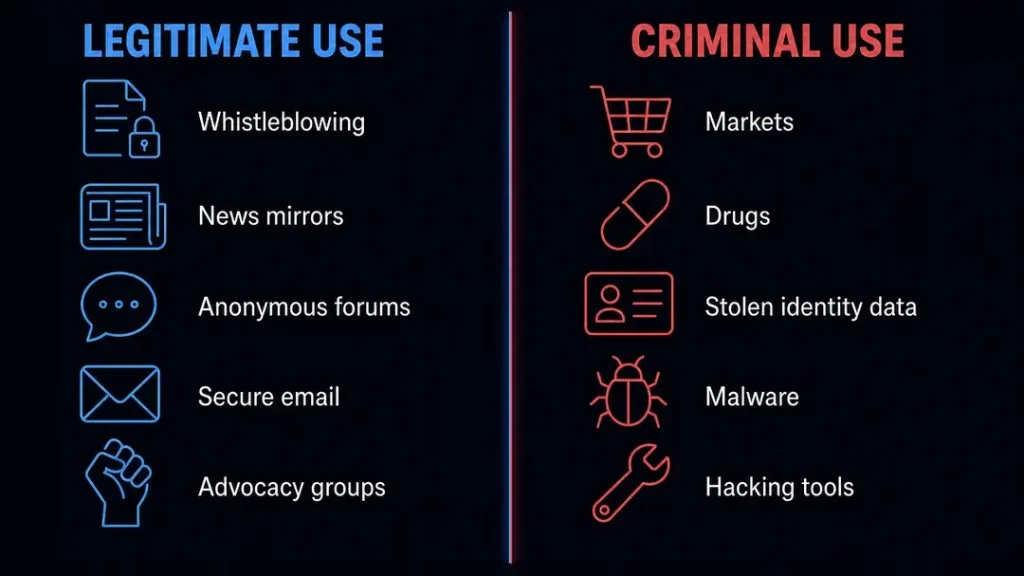
The dark web is a concealed area of the internet that can be accessed with specialist software like Tor. It supports both legal privacy-focused activity and illicit cybercrime operations. However, the primary purpose of creation isn’t for illegal activity; it was created for safe and secure communication. But cybercriminals exploit its anonymity. Here’s a sample of what’s available on the dark web:
Marketplaces
Dark web markets function similarly to eBay or Amazon underground, and the honest version is that drugs and stolen data dominate the listings. Archetyp, dismantled by a six-country operation in June 2025, ran around 17,000 listings and moved at least €250 million across roughly 3,200 vendors and 600,000 users before police reached its administrator in Barcelona (Eurojust press release). Around those markets sits a long tail of hacked accounts, counterfeit documents, digital goods and privacy services. Cryptocurrencies are used in the majority of transactions on these websites, giving everyone an additional degree of anonymity.
Platforms for Whistleblowers
The dark web is an essential resource for journalists and activists to securely share private information. Whistleblowers can disclose documents without disclosing their identities thanks to platforms like SecureDrop and GlobaLeaks.
The BBC has run a Tor mirror of its World Service since 2019, so readers in countries that block it can still get through. The New York Times ran one from 2017 until it retired the service in early 2025, though it still accepts tips through SecureDrop. Newsroom onion sites come and go; the underlying practice of accepting anonymous tips has not.
Social networks and forums
The dark web offers social media sites and forums where users can interact anonymously, just like the surface web. These groups typically concentrate on tech-related issues like coding, gaming, cybersecurity, and online privacy, but you can also discover conversations about politics, philosophy, conspiracy theories, and a variety of other themes.
Services for Email
For customers who wish to add a degree of secrecy and anonymity to email correspondence, several secure email providers, including Riseup and Proton Mail, offer onion sites.
Advocacy and Nonprofit Organizations
Plenty of civil liberties groups run onion services of their own. The EFF put eff.org, Certbot and Surveillance Self-Defense on Tor in April 2023. Amnesty International followed in December that year. Privacy International, the Freedom of the Press Foundation and the Tor Project itself all maintain onion addresses too.
Legal and Illegal Use of The Dark Web
Legal applications
This is a tool for safety and freedom for a lot of people. These covert websites are frequently used by abuse victims, whistleblowers, and dissidents to communicate without worrying about their identities being revealed. People who are subject to stringent censorship rules utilise the dark web to get around restrictions and have unrestricted access to communication and information.
Freedom of speech: People living in authoritarian nations were able to get around internet restrictions imposed by their governments by using the dark web.
Anonymous emails: Although the surface web offers a number of encrypted email providers, individuals seeking an additional degree of privacy can visit the dark web.
Anonymous cooperation with media: Some individuals, like whistleblowers, may only feel at ease communicating with journalists while remaining anonymous. As a result, they enable anonymous contact via the dark web between journalists and sources.
Get in touch with the CIA anonymously: The CIA maintains an official presence on the dark web, despite the fact that it might seem improbable for a government organisation to be there. The agency published its onion address in May 2019 for people who wish to get in touch but are worried about being followed.
Academic research: Accessing academic research can occasionally be prohibitively expensive; a single publication frequently requires a substantial payment.
Engage in forums and chat boards: The dark web is home to forums and chat boards that unite groups of people who wish to discuss topics anonymously that they might find awkward to discuss otherwise.
Illegal applications
Criminals find refuge in the same anonymity that shields whistleblowers. The sharing of illicit content, cyberattacks, and the trafficking of illicit products and services are all commonly accepted behaviours. Members of the dark web can purchase anything from narcotics to stolen personal information on these illicit marketplaces.
Scams: A lot of “hitman” services and absurd proposals are merely frauds intended to steal money or personal information.
Drugs and dangerous substances: These include hard drugs, marijuana, and potentially harmful compounds. Archetyp was one of the few markets that allowed fentanyl and other synthetic opioids, which is a large part of why it drew the response it did.
Stolen data and false identification: Credit card details, social security information, hacked streaming accounts, and even phoney passports. Our breakdown of identity theft and the dark web covers what those records actually sell for, and it is less than most people expect.
Malware and hacking tools: Phishing kits, ransomware builders, stealer logs and access brokering. This is the category that most often ends up affecting people who have never opened Tor in their lives.
The sensational end of the catalogue: Weapons, explosives, radioactive material and poisons do appear in listings. The uranium and ricin ads that generate headlines are overwhelmingly frauds or law enforcement stings rather than working supply chains. Treat that end of the market as marketing copy, not inventory, and apply the same scepticism you would to a “hitman” listing.
Is it safe to use the Dark Web?
Although the risks associated with the dark web are much greater than those associated with the surface web, it is not intrinsically harmful. Users may come across phishing efforts, fake markets, ransomware operators, dangerous websites, fraud, and illicit content.
Downloading files, clicking strange links, or interacting with unreliable services can also expose users to malware and cyberthreats. Kindly note that simply visiting the dark web does not inherently infect a device. Users will fall victim to cyber threats before their devices can be affected.
When investigating dark web environments, organisations and people should employ robust security procedures, such as updated software, multi-factor authentication, endpoint protection, and secure surfing techniques.
Dark Web Explained: Country-by-Country Legal Status
To begin with, is Tor legal and accessible in every country? The simple answer would be NO, but it depends on where you live and how you utilise it. Simply utilising the Tor network is legal in the majority of nations.
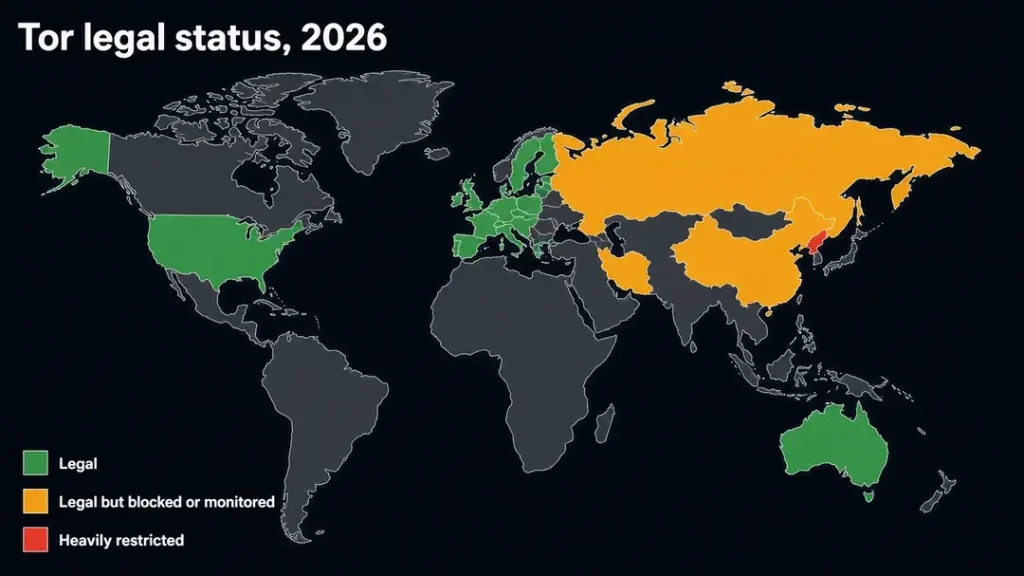
However, using it can get you into problems in countries like China, Iran, or Russia because governments frequently view Tor as a challenge to their control over information, not because of what you do on it. The legal status of Tor and dark web access in some nations as of 2026 is as follows:
United States: Completely lawful. The US government provided some funding for Tor. The First Amendment protects the use of Tor. Tor usage may be monitored by law enforcement, although using it is not prohibited.
UK: Lawful. Tor has not been outlawed by the UK government. However, intelligence agencies are granted extensive monitoring powers by the Investigatory Powers Act 2016, expanded further by an amendment act in 2024.
European Union: Legal in every EU member state. Several European government agencies and research programmes have funded Tor work over the years, Sweden’s Sida among them.
Australia: Legal, with no specific restrictions on Tor. The government passed the Assistance and Access Act in 2018, which gives agencies powers to compel technical assistance from providers.
China: Although Tor is not specifically prohibited, it is blocked by the Great Firewall. The block can be circumvented by using Tor bridges. Enforcement concentrates on the distribution of circumvention tools, though individuals have been fined for using them.
Russia: Tor use has never been criminalised outright, but the picture keeps tightening. ISPs began blocking torproject.org on 1 December 2021, acting on a 2017 Saratov court ruling. An appeal court lifted that block in May 2022 after the Tor Project’s lawyers showed the original case had proceeded without notifying the site’s owner, and the regulator delisted the site that July. The bigger change came on 1 September 2025, when a new law took effect imposing fines of 3,000 to 5,000 rubles for deliberately searching for “extremist” material online, including through a VPN, plus fines of up to 500,000 rubles for advertising VPN services (Human Rights Watch). The first known case was opened in Sverdlovsk region that November. Millions of Russians still reach Tor through bridges.
Iran: Not criminalised, but blocked. Iranians reach Tor using bridges and pluggable transports, particularly during shutdowns.
North Korea: Internet access is strictly regulated. Because citizens do not have general internet access, using Tor is not specifically addressed.
Dark Web Meaning: Common Myths and Facts About the Web
When people hear the term “dark web,” they immediately think of the digital criminal underworld where operations such as drug trading, weapon sales, and credit card theft take place. We are aware that you most likely have heard one or more unsettling tales about the dark web. However, it is important to know that not everything that occurs there is illicit, and not all statements about the web are true either. Here are some of the common and popular dark web myths you should know.
The Dark Web Is Completely Illegal
The idea that everything on the dark web is illegal by definition is among the most widespread rumours. This narrative is untrue. Simply accessing it is not illegal, but carrying out an illegal behaviour is. The dark web is a network layer that prioritises privacy and allows for anonymous communication. User behaviour, not technology, is the only factor that determines legality.
The Dark Web Is Totally Untraceable and Anonymous
This idea misinterprets both human behaviour and technology. The idea that anyone utilising the dark web becomes invisible, immune to tracking, surveillance, or identification, is another enduring misconception that is untrue. The 2025 takedowns make the point better than any argument can: Operation RapTor produced 270 arrests across ten countries and over $200 million seized, and Archetyp’s administrator was arrested at home in Barcelona after five years of running the market.
Accessing the Dark Web is challenging and requires specialised knowledge
Another common misconception about the dark web is that it’s a highly technological world that only skilled hackers can access using complicated tools and commands. This is untrue. Accessing the dark web is rather simple from a technological standpoint. Anyone who can access the surface web can access the dark web.
Visiting the Dark Web is inherently risky
Although there are risks associated with accessing the dark web, it is not always present. This is a misconception that one is immediately at risk of malware infection, surveillance, or legal repercussions just by accessing the dark web. Before you fall victim to cyber threats, you must have been vulnerable in one way or the other.
Red rooms are real
This is unverified. Despite thousands of internet allegations that red rooms exist on the dark web, their existence has never been confirmed. These so-called red room websites are hoaxes set up to deceive people into financial or data traps. We took the claim apart in full in Red Rooms: Myth or Reality?, and looked at the wider genre of hoax footage in our piece on dark web videos.
The dark web is only used by criminals
The truth of the dark web is completely disregarded by this fallacy, particularly the user groups that depend on anonymity for freedom or survival. Journalists and editors, human rights advocates, whistleblowers, security researchers and abuse survivors all show up in the Tor Project’s own account of who its users are.
The Dark Web Is Greater Than the Regular Internet
This is untrue. The dark web is a small portion of the entire internet. It gained its reputation because criminals exploit it, not because of its size.
You will see confident percentage splits for the three layers quoted everywhere: 4% surface, 90% deep, less than 1% dark. Treat those numbers with caution. They descend from a 2001 study of database-backed content and have never been reproduced with any rigour. Nobody can measure the deep web, because by definition it isn’t indexed. What can be measured is Tor itself, and the Tor Metrics portal publishes it. We keep our own running tally in Dark Web Statistics 2026, and we break down the layer model properly in the dark web iceberg.
The dark web was created by criminals to safeguard their operations
Not true. The brains behind the development of onion routing are Paul Syverson, David Goldschlag, and Michael Reed, working at the U.S. Naval Research Laboratory. The aim was to design an encrypted communications channel between the government and its operatives overseas.
The majority of Tor users are criminals
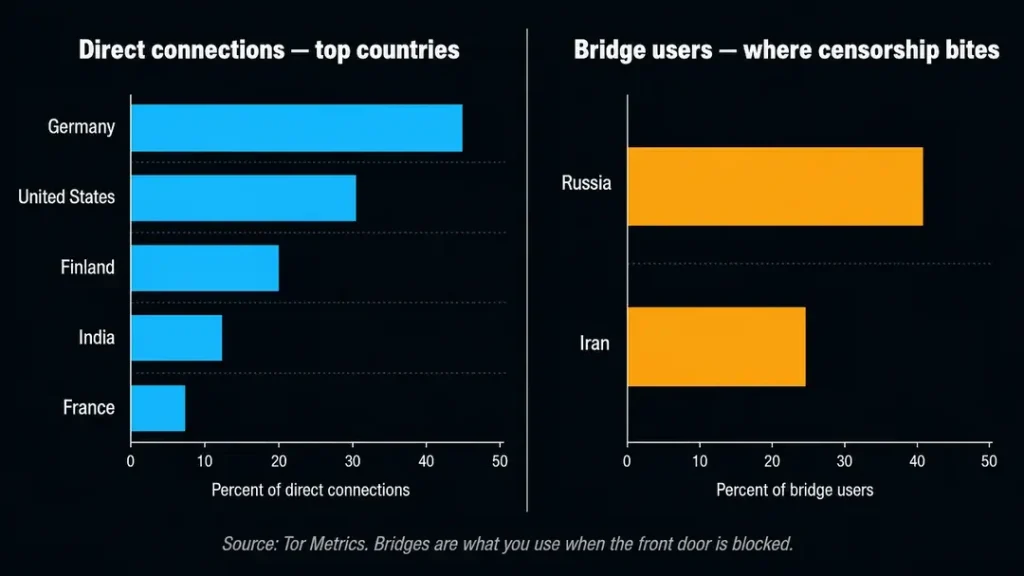
This is untrue, but the usual version of this rebuttal gets the numbers wrong, so here is the accurate one. Roughly 2 to 2.5 million people connect directly to Tor on a typical day, with several hundred thousand more connecting through bridges. That is not the same as 2 million people on the dark web. Only a small single-digit percentage of Tor traffic ever reaches an .onion service; the rest exits to the ordinary clearnet.
The country breakdown is also usually reported backwards. Germany and the United States consistently lead on directly connecting users, with Finland, India, France, the Netherlands and the UK filling out the top ten. Russia and Iran lead on bridge users, which is the more telling figure, because bridges are what you use when your government is blocking the front door.
Google indexes .onion websites
In theory, Google is unable to index .onion services. Its indexing robot, Googlebot, does not support the Tor protocol and uses normal protocols (HTTP, HTTPS) to traverse the clearnet. Even if it did, it wouldn’t be able to find .onion addresses because they aren’t included in a public DNS, and their structure makes systematic discovery impossible. The .onion suffix is formally reserved as a special-use domain under RFC 7686 precisely so it never resolves through the ordinary DNS.
You can only access the dark web through Tor
Tor is the most popular way in, thanks to ease of use and accessibility, but it is not the only anonymity network out there. Here is the correction that most articles get wrong, though: those other networks do not open .onion sites. Only Tor resolves .onion addresses. The alternatives run their own separate namespaces.
I2P hosts “eepsites” on .i2p addresses and is built around a different routing model. Hyphanet hosts “freesites” on a distributed datastore; it was called Freenet until March 2023, when the original project was renamed and an unrelated Rust project took over the Freenet name, so anything written before then needs reading carefully. GNUnet is a research framework rather than a browsable dark web. ZeroNet still gets listed in articles like this one, but its original development stalled years ago and only community forks remain.
Dark Web AI Tools & Uncensored Models
Cybercrime is evolving fast because of artificial intelligence, and the dark web is where a lot of the tooling gets advertised. Criminals use it to automate phishing, generate malware variants, produce deepfakes for fraud, and lower the skill floor for attacks that used to require real expertise.
The name most people know is WormGPT, and its story is more interesting than the usual list of scary product names. The original ran on GPT-J, sold for around $110 a month, and shut down in August 2023 after a journalist exposed its creator. It didn’t stay dead. Cato Networks found two new variants posted to BreachForums in October 2024 and February 2025, and when researchers jailbroke them, both turned out to be commercial models wearing a costume: one running on Grok, the other on Mixtral, both delivered through Telegram bots. WormGPT had become a brand rather than a model.
That is the pattern worth understanding. Most “uncensored LLMs” sold underground are jailbroken frontier models with a system prompt, not custom-trained tools, and a good number of them are outright scams aimed at other criminals. The documented names include FraudGPT, GhostGPT, EvilGPT, DarkGPT, WolfGPT and EscapeGPT. Note also that much of this trade has migrated to Telegram rather than onion markets.
We track this category in detail in Dark Web LLMs: FraudGPT, WormGPT and Beyond, with a dedicated breakdown of FraudGPT.
Cybersecurity teams are using AI on the other side of this too, tracking dark web activity, flagging illicit transactions and detecting AI-generated attacks.
Dark Web Protection: Safety Advice for the Dark Web
Avoiding dubious websites is not enough to stop dangers coming from the dark web. Regretfully, even if you never visit the dark web, attackers can still take advantage of you. Oftentimes, thieves may gather stolen data from hidden marketplaces and use it in a very mundane way, such as making phoney calls from your “bank,” sending phishing emails like the ones in our Coinbase text scam guide, or initiating a credit card charge in your name. Here are some tips for using the dark web safely:
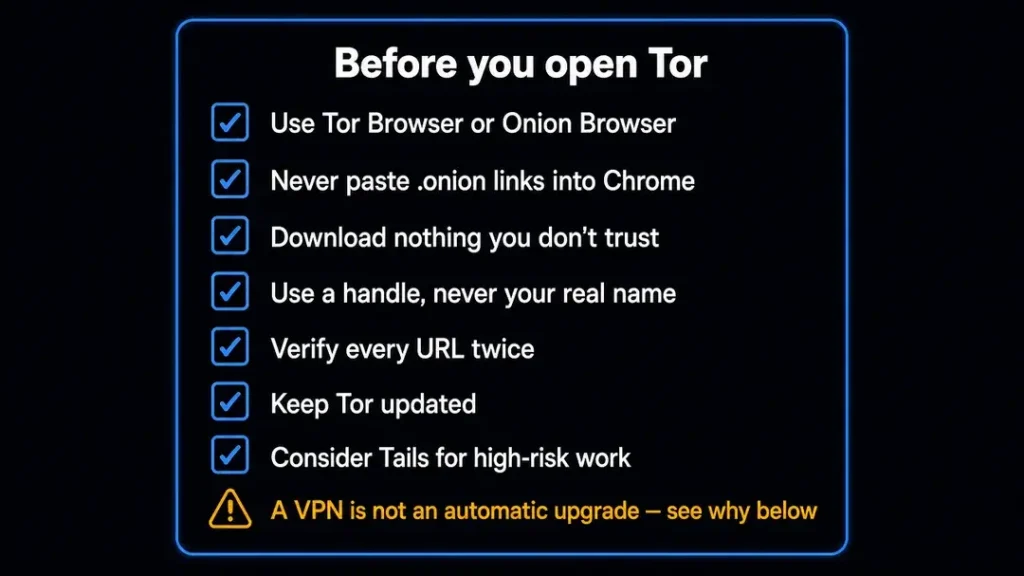
Make use of a browser that supports Tor. Use Tor Browser on desktop, or Onion Browser on iOS. Because Chrome, Safari, and other standard browsers do not offer Tor’s safeguards and may reveal your IP address, you should never paste .onion links into them. Our dark web mobile apps guide covers the iOS and Android options and their limits.
Steer clear of downloading random files, because many dark web files are infected. Dangerous code can be found in even seemingly harmless PDFs and photos. Download only if you have complete faith in the source, and even then, think about opening files offline or in a secure location.
Don’t reveal any private or sensitive information. Use a fictitious handle or name at all times. When creating accounts or participating in discussions, never use your real name, primary email address, or any other personal information.
Think carefully before adding a VPN. You will see this recommended everywhere as a free extra layer, but the Tor Project itself does not recommend it unless you’re an advanced user who knows how to configure both without compromising your privacy. The reasoning is that Tor is designed to be trustless, and a VPN reintroduces a single party who can see who you are. A VPN does hide Tor use from your ISP, which matters in some countries. Know which problem you’re solving before you add it. The Tor Project also shipped its own Android Tor VPN in beta in September 2025, with an explicit warning that it isn’t for high-risk users.
Watch out for dubious offers such as free Bitcoin or miracle investments. Many of them are frauds intended to steal your personal data or cryptocurrency.
Keep an eye out for phishing. Some dark web pages imitate reputable services to lure you into entering passwords or wallet information. Verify URLs twice, and don’t log in to anything unless you are certain it is authentic.
Update Tor. The Tor Browser is patched regularly. Ignoring updates leaves you exposed to attacks using vulnerabilities that have already been fixed.
Advanced optional tools: Consider creating a virtual machine or using a live operating system like Tails if privacy is a major concern.
Smart browse anywhere. Malware may unintentionally be downloaded from hacked “normal” websites. Safe browsing habits are your constant line of defence.
Utilise dark web monitoring tools. These search for your information across obscure forums, encrypted channels and illegal marketplaces, and alert you when something surfaces. We’ve reviewed the main options, including Aura and Norton, and there’s a reason we say no to paid removals. If you want to see what a real exposure looks like after the fact, our write-up of the T-Mobile settlement is a good place to start.
In conclusion
The dark web serves as both a legitimate threat layer and a valuable source of intelligence for enterprises. Knowing how it operates, who frequently uses it, and the risks involved is genuinely useful. That information matters for people and companies coping with today’s cybersecurity environment.
Additionally, proactive monitoring of dark web activity is becoming a crucial component of contemporary security procedures because threats are always evolving. If you monitor underground groups, you may be able to identify new or emerging risks, leaked passwords, and indications of ransomware activity before they interfere with regular operations.
Organisations can monitor exposed credentials, leaked information, and new dangers across underground forums and marketplaces using trusted monitoring tools. This allows teams to identify issues more quickly and take action before they become costly breaches.
Frequently Asked Questions (FAQs)
What is the difference between the Tor Network and the Tor Browser?
The Tor Network and the Tor Browser are two distinct things. Your internet traffic is routed and encrypted via the Tor Network, a set of volunteer relays that protects your identity. The Tor Browser is the tool that makes it simple to reach that network: a hardened version of Firefox, modified for anonymity and stripped of the features that leak identifying information.
Is it legal to use a VPN in conjunction with Tor?
Yes, in most countries it’s legal. Whether it’s a good idea is a separate question. The Tor Project doesn’t recommend combining them unless you know how to configure both correctly, because a badly set up VPN can reduce your anonymity rather than add to it. It does hide your Tor use from your ISP, which is the main reason people in censored countries use the combination.
Is it against the law to download Tor?
No, downloading Tor is permitted in the majority of nations. You can download and use it freely in countries including the US, Canada, and Australia. Several nations with stringent internet censorship, including China, Russia, and Iran, either block access to Tor or closely monitor its use.
Is it possible for Tor to ensure your online privacy and safety?
No. Tor encrypts your traffic within its network and conceals your IP address, but it is not shielded from every type of threat, and its own designers say it cannot defend against an adversary watching the whole network. You need additional precautions for meaningful protection.