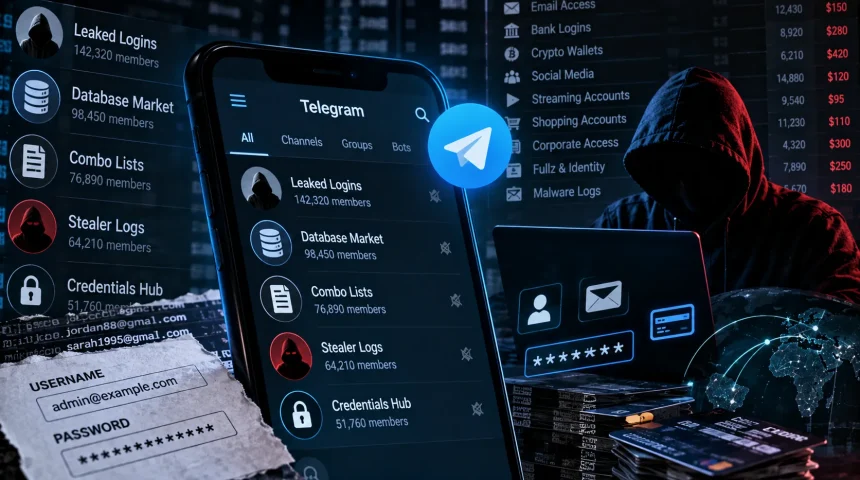
Telegram is no longer just a messaging app for chatting and sharing files. Security researchers have found that parts of the platform are also being used to distribute stolen credentials, infostealer logs, breached databases and other cybercrime data.
That has made Telegram an important source of threat intelligence.
A 2025 USENIX Security study called DarkGram identified hundreds of cybercrime-related Telegram channels, including channels focused specifically on compromised credentials. The researchers found that credential-compromise channels shared account credentials and, in some cases, stolen session cookies.
But it’s important to understand that not every Telegram leak is genuine. Some posts contain old breach data, recycled information or fake samples designed to attract buyers.
So, what are the main types of Telegram leak channels?
1. Credential Dump Channels
These channels are most closely associated with what people search for as Telegram leaks or “best Telegram leaks.”
Their main purpose is to distribute usernames, email addresses, passwords and other login information obtained from data breaches or infected devices.
Some posts may contain only a small sample. Others may advertise much larger databases or direct users toward private groups.
Researchers studying Telegram cybercrime activity have identified credential compromise as a distinct category of criminal channel. Some posts also include screenshots or other “proof” intended to convince potential buyers that the credentials work.
For defenders, these channels can provide an early warning that an employee or customer account may have been compromised.
For ordinary users, however, seeing an email or password in a Telegram leak doesn’t necessarily mean the password came from the company named in the post.
Malware could have stolen it months earlier.
2. Infostealer Log Channels
Infostealer logs are one of the biggest reasons Telegram has become relevant to credential theft.
An infostealer is malware designed to collect information from an infected device. Depending on the malware family, this can include saved passwords, browser cookies, session tokens, autofill information and other data.
The stolen information is then packaged into logs and sold or distributed through criminal communities.
Flare found that thousands of corporate SSO credentials had appeared in stealer logs distributed through dark web markets and public and private Telegram channels. The company also reported that private Telegram channels distributed higher-value logs.
This is one reason a Telegram leak channel can be more dangerous than a simple database dump.
A stolen password may be changed.
A stolen session cookie can sometimes give an attacker access without asking for the password again.
Dark Web Decoded’s guide on infostealer logs and stolen credentials explains why this type of malware creates a different kind of breach risk.
3. Breached Database Channels
Another major category involves databases stolen from companies, websites and online services.
These posts can contain names, email addresses, phone numbers, addresses, account information and other personal data.
Some channels act more like leak aggregators. They do not necessarily carry out the original attack. Instead, they collect and redistribute information that has already appeared elsewhere.
Academic research published through USENIX found that stolen-data Telegram channels can be highly specialized. Researchers identified categories including breached databases, personal information, account credentials and infostealer logs.
This creates a major problem for victims.
A database may be stolen once but copied many times.
Even if the original criminal marketplace disappears, the same information can continue circulating through different Telegram groups, forums and file-sharing services.
4. Private Credential Trading Groups
Not all Telegram leaks are posted publicly.
Some criminal communities use private Telegram leak groups where access is restricted to members, buyers or subscribers.
Security researchers have reported that private channels can be used for higher-value credential and infostealer data. Flare found that corporate credentials were disproportionately represented in private channels compared with public Telegram posts.
These groups are harder for outsiders to monitor.
They can also change names, move to new channels or disappear when administrators believe they are being watched.
That makes phrases such as “best Telegram leak group” or “best Telegram for leaks” misleading. No reliable, permanent ranking exists for these communities, and a channel that appears active today may be gone tomorrow.
5. Combo List and Account-Takeover Channels
Some Telegram communities focus on collections of previously exposed usernames and passwords.
These are often called combo lists.
The danger is credential stuffing.
If someone uses the same password on several websites, criminals may test an exposed email-and-password combination against other services.
For example, a password leaked from a gaming website could potentially be tried against an email account, shopping account or business service.
This is why one leaked password can become a much larger security problem.
Europol’s 2025 Internet Organised Crime Threat Assessment described stolen credentials as a commodity that criminals sell and reuse across different criminal activities, including fraud and attacks against organizations.
Why Are Telegram Leak Channels Growing?
Speed is one major reason.
Telegram makes it easy to create channels, distribute files and reach large audiences quickly. Criminal groups can also use bots and automated systems to organize data.
Recent threat intelligence reporting has described Telegram as an increasingly important distribution point for infostealer logs. One 2026 report found that Telegram accounted for a large share of newly observed infostealer data during its reporting period.
Telegram is therefore becoming part of the wider cybercrime supply chain.
The original breach may happen on one website.
An infostealer may steal the credentials from someone’s computer.
A criminal may then package the information into a log.
Another actor can redistribute it through Telegram.
Finally, a completely different attacker may use the stolen credentials to take over an account.
Are Telegram Leaks Always Real?
No.
This is one of the most important things readers should know.
A Telegram post claiming to contain millions of leaked accounts is not proof of a successful data breach.
Threat actors may recycle old databases, combine information from several incidents or publish fake samples.
Security researchers therefore compare leaked information with known breach records, timestamps, infrastructure indicators and other evidence before treating a claim as credible.
The same rule applies to a company appearing in a dark web monitoring alert. As we reported in our ValueFirst dark web alert investigation, an underground listing alone does not establish that a company’s systems were breached.
What Should You Do If Your Data Appears in a Telegram Leak?
Don’t panic, and don’t try to contact or buy the leaked data.
Instead:
- Change the affected password immediately.
- Never reuse that password elsewhere.
- Enable MFA or passkeys where available.
- Sign out of suspicious sessions.
- Watch your email and financial accounts for unusual activity.
- Be careful with unexpected password-reset messages.
- Treat messages containing personal information as possible phishing attempts.
If the exposed data came from an infostealer infection, changing passwords alone may not be enough. Also check and clean the infected device before using sensitive accounts again.