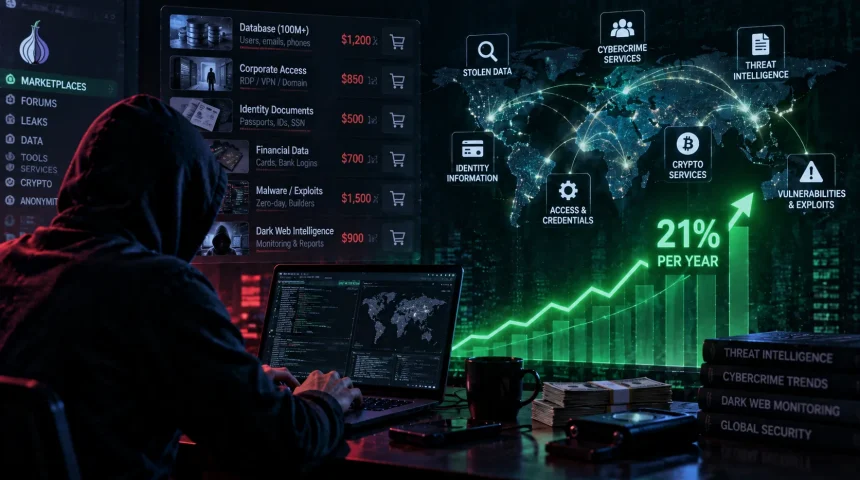
The dark web intelligence market, estimated at $0.92 billion in 2026 by The Business Research Company, is projected to reach $1.99 billion by 2030 at a 21.3% CAGR. Growth is driven by rising enterprise demand for proactive credential monitoring, AI-powered threat analysis, regulatory compliance requirements, and accelerating cybercrime activity that increasingly originates on dark web forums and marketplaces before reaching mainstream headlines.
The global dark web intelligence market was valued at roughly $760 million in 2025. By 2026, multiple research firms estimate it will cross $920 million. By 2030, it’s projected to reach $1.99 billion, a 21.3% compound annual growth rate that places it among the fastest-expanding segments in the entire cybersecurity industry.
The question worth asking isn’t just “how big is this market” but “what’s actually driving businesses to spend this kind of money watching what happens in corners of the internet that most people will never visit?”
What Dark Web Intelligence Actually Is
“Dark web intelligence” covers a specific set of activities: monitoring hidden online spaces, primarily the Tor network, for information that indicates a threat to an organisation or individual. What gets monitored includes underground forums where cybercriminals discuss attack targets, marketplaces where stolen credentials and access to breached networks are traded, and leak sites where ransomware groups publish data from victims who refused to pay.
Intelligence from these sources does what internal security tools can’t: it gives organisations visibility into threats before they reach their front door. A company whose database credentials are being sold on a dark web marketplace hasn’t been hacked yet. But if no one checks, the breach announcement becomes the first notification they receive.
This shift, from reactive incident response to proactive threat monitoring, is the single biggest driver behind the market’s growth. As we covered in our analysis of how supply chain attacks show up on the dark web before they become public, the warning window between underground activity and public breach disclosure can be days, weeks, or months. Dark web intelligence is the product built to read that window.
The Numbers: What Different Analysts Say
It’s worth being honest about market-size figures here because different research firms produce notably different estimates.
The Business Research Company puts 2026 market value at $920 million, growing to $1.99 billion by 2030 at a 21.3% CAGR. Research and Markets’ separate analysis values the 2026 market at $667 million, reaching $1.19 billion by 2032 at a more conservative 10% CAGR. Dataintelo’s estimate is even higher, $1.3 billion in 2025, growing to $5.1 billion by 2034 at 16.4% CAGR. DataM Intelligence’s analysis projects the market reaching $1.7 billion by 2030 at a 21.7% CAGR.
Why do these figures differ so significantly? Largely because analysts define the market’s scope differently. Narrower definitions count only pure-play dark web monitoring software and services. Broader definitions include adjacent threat intelligence categories, credential monitoring, data leak detection, breach notification services, and even related hardware like forensic tools and secure monitoring infrastructure.
Every estimate agrees on the direction: double-digit annual growth through 2030 and beyond. No research firm is projecting this market to slow down.
What Is Driving the Growth
Cybercrime volume. The most fundamental driver is simple: dark web criminal activity has increased significantly and continues to rise. The Australian Signals Directorate reported a 16% year-on-year rise in cybersecurity incident calls to its national hotline in FY2024-25, and Australia is no exception. The US recorded over 3,500 publicly disclosed data breaches in 2024, a 72% increase over 2022 figures. More incidents create more demand for the early warning systems designed to detect them before they escalate.
Regulatory mandates. Governments are requiring organisations to demonstrate more active security monitoring. The US Executive Order 14028 on Improving the Nation’s Cybersecurity created procurement requirements that accelerated government-sector investment in threat intelligence platforms. The US federal cybersecurity budget exceeded $13 billion in fiscal year 2025. CISA’s strategic plans explicitly incorporate dark web monitoring capabilities into federal security posture requirements. European regulatory environments, including NIS2, are similarly pushing organisations toward proactive threat monitoring rather than passive defence.
AI and ML integration. Dark web intelligence platforms entering the market today aren’t built the same way as those from five years ago. Modern platforms use machine learning to automatically identify patterns across millions of forum posts, correlate credential dumps with specific organisations’ domains and employee email formats, and generate specific, rather than generic, alerts. Recorded Future launched an AI-enhanced platform in March 2026 specifically designed for real-time threat correlation and automated credential detection. The predictive capability, not just what happened but what is likely being planned, is what’s driving enterprise upgrades from older monitoring tools to current-generation platforms.
Cloud adoption. Cloud-based deployment is now the dominant model for dark web intelligence tools, replacing on-premises infrastructure. This makes the tools accessible to mid-sized organisations that couldn’t justify the capital expenditure of on-premises threat intelligence infrastructure. It also enables continuous update cycles rather than periodic release schedules, which matters in a sector where threat actor tactics change faster than quarterly software updates can track.
Managed services growth. Many organisations don’t have security teams large enough or experienced enough to operate dark web monitoring platforms directly. The managed dark web intelligence service model, where a third-party provider monitors on an organisation’s behalf and delivers curated alerts, is growing faster than the software segment. This is particularly significant for SMEs, which make up a meaningful portion of the market’s expansion even though enterprise security teams have historically dominated dark web intelligence investment.
Why 2026 Made This Market More Urgent
Abstract market growth figures make more sense when you connect them to what’s actually been happening.
The AudiA6 cryptocurrency laundering takedown in June 2026 exposed a service that had processed nearly $400 million in ransomware proceeds through 6,000-plus fraudulent exchange accounts. The intelligence that helped build that case came precisely from the kind of underground forum monitoring and blockchain analysis that dark web intelligence platforms perform. Years of proactive monitoring, not a response to a single incident, enabled the law enforcement outcome.
The 153 million US driver’s licence exposure through IDScan.net appeared on a dark web service called Nexus before the FBI formally opened the investigation. For any organisation whose employees or customers have data in databases like that, a dark web monitoring platform configured to watch for its domain names and employee email patterns could have flagged the exposure before the story went public.
The SilentRansomGroup campaign that hit Greenberg Traurig and five other law firms in late August and early September 2026 listed stolen data on leak sites that dark web intelligence platforms monitor continuously. Organisations with active monitoring receive those alerts within hours of a listing appearing. Organisations without it read about themselves in the news.
These aren’t cherry-picked cases. They represent what a normal operating week in 2026 looks like across the dark web intelligence space, which is why the market is expanding at 21%.
Who the Major Players Are
The competitive landscape spans pure-play dark web intelligence vendors, broader cyber threat intelligence platforms, and large cybersecurity companies that have acquired specialist capabilities.
Recorded Future remains the market leader in enterprise threat intelligence, with its platform now covering dark web monitoring alongside open-source intelligence and technical indicators. Its March 2026 AI-enhanced release specifically addresses the predictive analysis gap, moving from detecting what was posted to correlating what’s likely being planned.
Flashpoint focuses heavily on illicit community monitoring, with deep coverage of underground forums where threat actors discuss targets and techniques. Its particular strength in criminal community linguistics, understanding the evolving slang and coded language of specific criminal networks, is a capability general-purpose threat intelligence platforms struggle to replicate.
ZeroFox expanded significantly through its acquisition of LookingGlass Cyber Solutions in April 2023, consolidating external attack surface monitoring and dark web intelligence into a single platform for large enterprise and government clients.
KELA Group and Cybersixgill both specialise specifically in dark web and underground intelligence, with platforms designed around continuous crawling of criminal forums and automated alert generation tied to client-specific keywords and digital assets.
DarkOwl LLC built its entire business model around dark web data collection and API access, providing the underlying intelligence layer to organisations that want to build monitoring capabilities into their own security stacks.
Group-IB, the Singapore-headquartered threat intelligence firm, is notable for its hybrid model: AI-driven dark web monitoring combined with a team of human analysts fluent in criminal community languages, producing intelligence that automated systems alone miss.
At the intersection of dark web intelligence and national security AI, South Korea’s government-funded 700B parameter security model, being developed by a 33-organisation consortium including S2W, Naver Cloud, LG AI Research, and KAIST, represents what the next generation of state-level dark web intelligence capability looks like. S2W’s DarkBERT, trained on over 6 million dark web pages, provides the intelligence data layer that powers a model specifically designed to understand the language of criminal forums at a depth general-purpose LLMs cannot achieve.
Who Is Buying and Why
Banking, Financial Services and Insurance (BFSI) is the largest application vertical in the dark web intelligence market. Banks and financial institutions monitor for stolen customer credentials, compromised payment card data, and threat actor discussion of specific institutions as targets. Financial regulators in multiple jurisdictions increasingly treat dark web monitoring as a required cybersecurity practice rather than a voluntary enhancement.
Government is the second-largest segment. Law enforcement agencies monitor dark web markets directly for criminal activity. Intelligence agencies track threat actors. Civilian government departments monitor for leaked operational documents and employee credentials. The Berlin government’s data breach by Rhysida, where the ransomware group listed stolen government data publicly on the dark web before Berlin formally acknowledged the incident, illustrates why government-sector demand for dark web monitoring has accelerated.
Healthcare is a rapidly growing customer segment. Medical institutions hold the most valuable personal data per record in any industry; medical records command higher prices on criminal markets than credit card numbers, and ransomware groups have increasingly targeted hospitals and healthcare networks. Dark web intelligence provides early warning of credential listings tied to healthcare institutions’ domains and advance notice of ransomware groups discussing specific healthcare targets.
Technology companies use dark web intelligence primarily to monitor for source code leaks, stolen API keys, and discussion of vulnerabilities in their own products before public disclosure. The Substack breach in early 2026 appeared on BreachForums before Substack’s own security team had detected the incident. A platform actively monitoring BreachForums for Substack-related data would have significantly changed that timeline.
North America Leads, Asia-Pacific Grows Fastest
North America holds the largest regional share of the dark web intelligence market, accounting for roughly 38% to 40% of global revenue depending on the analyst. The US contributes the largest share, driven by the concentration of leading vendors- Recorded Future, Flashpoint, ZeroFOX, ThreatConnect, and Proofpoint- all headquartered there, along with the most mature enterprise security investment environment globally and strong regulatory drivers from federal cybersecurity mandates.
Asia-Pacific is consistently identified as the fastest-growing region across multiple research reports. The dynamics are straightforward: rapid digital transformation across large economies, including India, South Korea, Japan, and Southeast Asia, has expanded the attack surface far faster than security infrastructure has scaled to match. The investment gap is closing, as shown by South Korea’s government-funded 700B dark web security AI project and India’s growing cybersecurity market, but growth in APAC remains substantially higher than in mature Western markets.
The ValueFirst dark web alert in India, involving a major CPaaS provider that routes banking OTPs for millions of users, reflects exactly why organisations in rapidly digitising markets are accelerating their own dark web monitoring investment. The alternative is learning about exposures from threat intelligence monitors rather than their own systems.
What the Growth Means for Businesses That Don’t Have Monitoring Yet
The market growth data points to something more specific than a sector becoming profitable for vendors. It reflects a genuine shift in how organisations think about where threats originate and how early they can be detected.
Dark web monitoring isn’t exclusively an enterprise product anymore. The expansion of managed services and cloud-based monitoring has significantly lowered the entry cost. Providers like DarkOwl, Cybersixgill, and Flare all offer tiered services that mid-market organisations can access at a fraction of what enterprise deployments cost five years ago.
For individuals, monitoring tools tied to personal email addresses, which check known breach databases and dark web credential listings against your specific identifiers, have also matured. This is meaningful given what the past year of breach reporting has shown: the Bank of Baroda’s customer KYC data, millions of US driver’s licences, law firm client data, and messaging platform user records are all in circulation. Understanding whether your specific identifiers are in those pools requires the same underlying capability, just applied at individual rather than enterprise scale. Our guide on what to do when your data shows up on the dark web covers the consumer-level equivalent.
Looking at 2030
The four major factors shaping the market through 2030 are already visible in what’s happening today.
AI integration will deepen. The transition from keyword-based monitoring to AI-driven pattern recognition and predictive threat analysis is already underway. Models like DarkBERT, trained specifically on criminal forum language, produce more accurate and earlier signals than general-purpose AI applied to the same data. Vendors who fail to build this capability in-house will acquire it, as ZeroFox demonstrated with LookingGlass.
Supply chain risk monitoring will expand. The 2026 supply chain attack campaigns we’ve documented across multiple industries have driven enterprise buyers to expand dark web monitoring beyond their own digital assets to include third-party vendors and partners. Monitoring for mentions of your critical suppliers on criminal forums is becoming part of standard procurement due diligence.
SIEM integration will become standard. Dark web intelligence delivered as a standalone alert is increasingly less valuable than dark web intelligence integrated directly into security information and event management platforms, where it can be correlated with internal network events in real time. Vendors building native SIEM integrations are gaining competitive advantage over those delivering intelligence through separate portals.
Regulatory compliance will expand the mandatory buyer pool. The global regulatory environment is converging on requirements for proactive threat monitoring. Organisations that currently treat dark web intelligence as optional are increasingly finding it will be mandatory for regulatory compliance in their sectors within the next 24 to 36 months.
Frequently Asked Questions
What is the dark web intelligence market worth in 2026?
The Business Research Company estimates $920 million in 2026. Other research firms cite figures ranging from $667 million to over $1 billion, depending on their market definition and scope. All estimates agree on consistent double-digit annual growth.
What is driving dark web intelligence market growth?
Rising cybercrime volume, regulatory compliance mandates, AI integration for predictive analysis, expansion of managed monitoring services, and growing enterprise awareness that threats originate on underground forums before becoming public incidents.
Who are the major players in dark web intelligence?
Recorded Future, Flashpoint, ZeroFox, KELA Group, Cybersixgill, DarkOwl, Group-IB, and Darktrace, among others. The broader threat intelligence sector also includes platform capabilities from CipherTrace (Mastercard), IntSights (Rapid7), and Digital Shadows (ReliaQuest).
Which industry uses dark web intelligence the most?
Banking, Financial Services and Insurance (BFSI) is the largest application segment. Government, healthcare, and technology are also significant buyers.
Which region leads the dark web intelligence market?
North America holds the largest share (approximately 38-40% of global revenue). Asia-Pacific is the fastest-growing region, with South Korea, India, and Japan accelerating investment significantly.
Will dark web monitoring matter for individual people, not just companies?
Increasingly yes. Managed monitoring services now offer individual-level credential and personal data monitoring at consumer-accessible price points, reflecting how widely personal data from major breaches circulates in underground markets