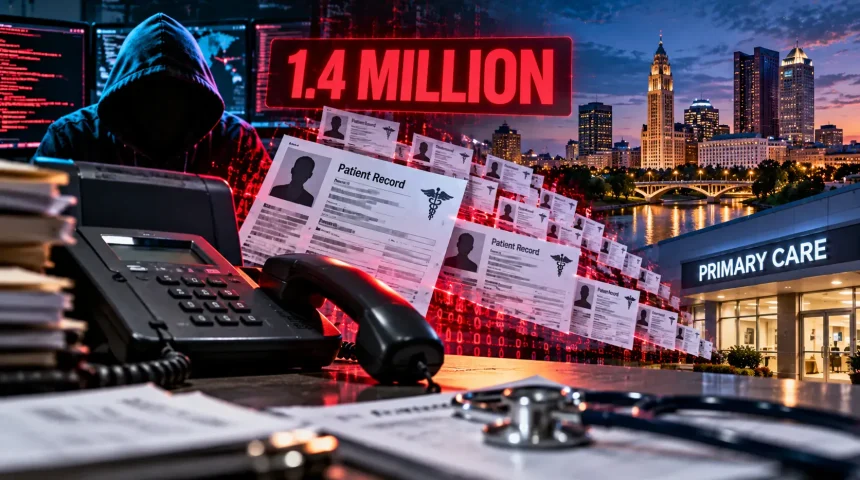
Central Ohio Primary Care Physicians, Inc. (COPC), the largest physician-owned primary care group in the country, has confirmed a cybersecurity breach discovered on August 25, 2026. The breach exposed personal information of about 1.4 million patients and employees. An attacker used a voice phishing scam, known as vishing, to access files with names, addresses, Social Security numbers, financial details, and some health data. COPC reports that the breach has been contained, no misuse has been found, and Epic MyChart was not affected. Free credit and dark web monitoring is available through IDX at response.idx.us/copc.
How the Attack Worked
This method, called vishing or voice phishing, is now the fastest-growing threat in healthcare IT security.
Unlike email phishing, which relies on someone clicking a bad link, vishing involves calling a real person and pretending to be a trusted authority until they give access, credentials, or take a financial action. Researchers at Vectra AI found that voice phishing incidents jumped 442% in late 2024 and made up over 60% of phishing-related incident responses by 2026. This rise is partly due to AI voice-cloning technology, which allows attackers to create convincing calls that sound like IT support, vendors, or coworkers.
For COPC, the call “sought a financial response” and allowed the attacker to access files with protected health information, according to WSYX ABC6. While the exact details of the social engineering are not fully shared, this type of attack is common: a caller convinces a staff member they are handling a real business need, and that one conversation leads to a breach.
This healthcare vishing wave isn’t isolated to COPC. In August 2026, the American Hospital Association published a specific warning about a ShinyHunters-linked social engineering and identity-targeting campaign targeting healthcare organizations. ShinyHunters, the same group connected to the Streamlabs breach and activity across the Twitch creator ecosystem, has increasingly turned toward healthcare targets in 2026 because the sector holds exactly the data combination most valuable for identity fraud: names, Social Security numbers, and health identifiers all in one database.
The Chaos Ransomware Layer
One detail not highlighted in COPC’s official notice but mentioned in cybersecurity briefings soon after August 25: a Morning Cybersecurity Update video from August 28, 2026, described the COPC incident as a ransomware attack by the Chaos ransomware group.
At first, the breach was reported to affect over 500,000 people. By October, when official HIPAA notifications were sent, the confirmed number had grown to 1.4 million.
The increase from 500,000 to 1.4 million affected people is important to note. COPC’s website says it serves over 500,000 patients at more than 80 locations, so the larger number includes more than just current patients. It also covers former patients, employees, dependents, referring clinicians, and others whose records were stored in the system. Healthcare records are kept even after patients stop visiting, and in this breach, the attacker accessed them before COPC closed off access on August 25.
What Was in the Exposed Files
COPC’s official notification lists the following categories of potentially exposed data:
Full names, addresses, Social Security numbers, financial information, limited health-related patient data including patient ID numbers, and other identifying information.
The most serious risk comes from Social Security numbers combined with health data. When financial records are paired with SSNs, it can lead to identity theft, fake credit applications, tax refund fraud, and account takeovers. Health records can also be used for medical identity theft, such as getting prescriptions, medical equipment, or billing for care using someone else’s information. This is why healthcare data is the most valuable type on the dark web. A healthcare record with an SSN can be used for several types of fraud at once.
One important thing is safe: Epic MyChart, the patient portal COPC patients use to talk with providers and see health records, was not affected. Patients can keep using MyChart as usual.
COPC’s Response and What They’re Offering Patients
COPC says it brought in cybersecurity experts, worked with law enforcement, and has contained the breach. CEO Don Deep said in a public statement that the company is adding stronger security measures to protect its systems and everyone who trusts them with their information. So far, there have been no reports of the exposed information being misused for identity theft or fraud.
The company is offering free credit and dark web monitoring through IDX, which is a common but important step after a breach. This offer covers up to all 1.4 million affected people.
If you are a current or former COPC patient, visit response.idx.us/copc to check if your records were affected and to sign up for IDX monitoring. COPC will send notification letters to affected people using the contact information they have on file. There is also a dedicated call center for questions.
If you do not get a letter but think you were a COPC patient in recent years, checking the portal is the best first step. For more advice on what to do if your healthcare or personal data is exposed, see our dark web data exposure guide.
The HIPAA Clock Was Already Running
COPC discovered the breach on August 25. Under HIPAA’s Breach Notification Rule, covered entities must notify affected patients and report to the federal Department of Health and Human Services within 60 calendar days of discovery, putting the federal deadline around October 24.
Ohio adds its own layer. Under Ohio Revised Code § 1349.19, notification must happen in “the most expedient time possible” and no later than 45 days from discovery, a deadline that likely landed around October 9. When a breach affects more than 1,000 Ohio residents, state law also requires notification to major consumer credit reporting bureaus.
Because of these overlapping deadlines, COPC had less time than the 60 days allowed by HIPAA. Patients started getting notifications around October 15-16, which could raise questions about meeting Ohio’s 45-day requirement.
The HHS Office of Civil Rights maintains a public breach reporting portal. Cases involving 1.4 million individuals are automatically added to its public “Wall of Shame” database, which can also trigger an investigation into whether the organization’s security policies met HIPAA’s required standards before the breach.
Why Healthcare Keeps Getting Hit
COPC is not an isolated case. As we covered in our look at the dark web intelligence market and what’s driving its 21% growth, healthcare consistently ranks as the second most targeted sector in US cybercrime, after financial services. A 2026 report by CyberCX specifically found healthcare more vulnerable to business email compromise and social engineering than other sectors, attributing this to the high concentration of small and medium-sized practices, GP clinics, specialist offices, and care groups that operate with lower security maturity.
Primary care networks like COPC are especially vulnerable. They collect records from many years of patient care, have large administrative teams handling sensitive data, and usually have fewer security resources than hospitals. One vishing call to the right person can give attackers access to decades of records for hundreds of thousands of people.
Frequently Asked Questions
What happened at Central Ohio Primary Care?
A voice phishing scam (vishing) gave an attacker unauthorized access to COPC’s systems. The breach was discovered on August 25, 2026, and is also referenced in cybersecurity briefings as a Chaos ransomware attack.
How many people were affected?
Approximately 1.4 million patients and employees.
What information was exposed?
Names, addresses, Social Security numbers, financial information, limited health data including patient ID numbers, and other identifying information.
Was Epic MyChart affected?
No. Patients can continue using MyChart normally.
What should affected patients do?
Visit response.idx.us/copc to check your status and enroll in free IDX credit and dark web monitoring. Report any suspected identity misuse to the FTC at IdentityTheft.gov.