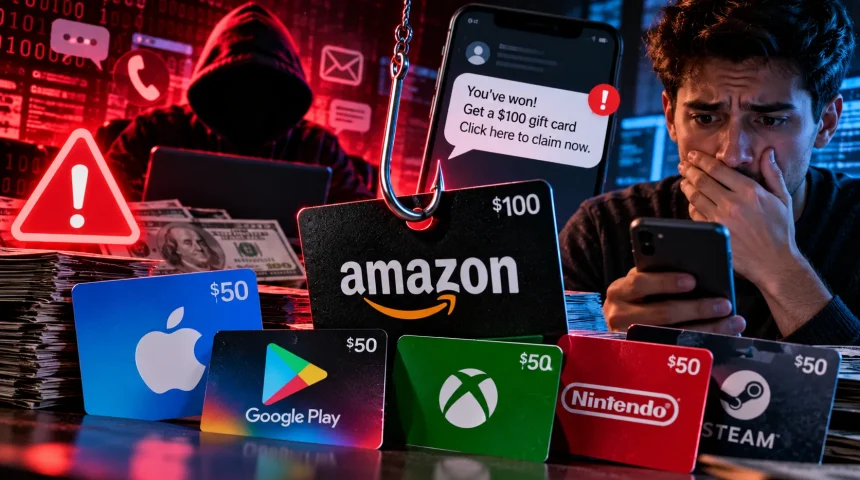
Gift card fraud costs American seniors over $8 billion annually, making it the leading scam payment method reported to the FTC. Fraudsters use a psychological technique called a “fear bubble” an induced panic state that overrides rational judgment , to pressure victims into buying gift cards at drugstores and supermarkets. Once the numbers are read out to a scammer, the money is gone. Gift card proceeds are immediately sold on dark web marketplaces, Telegram, and Discord.
How the Scam Started: One Bad Click
Mae opened her laptop and got a message. It said her Safari browser had a problem. It offered a link to connect her to the “Apple Computer Company.” She clicked.
A man calling himself Mac Morgan, an “Apple high-security technician,” told her the problem was actually coming from her bank.
From there, the script ran precisely. He told her to call her bank, M&T, at a number he provided. A woman called Alivia, supposedly from M&T’s fraud unit, answered. Alivia told Mae a European scammer had tried to withdraw $20,000 from her account overnight. A hold was in place, but Mae needed to go to the bank immediately and retrieve the money before the criminals did.
This is the fear bubble. Mae didn’t know it yet.
Anyone can fall into one. The technique is simple: create an extreme sense of urgency and danger, attach it to something the victim cares deeply about , their money, their safety, their family and keep them on the phone so they can’t think clearly or talk to anyone else.
At the Bank, Then the ATM, Then the Drugstore
Mae drove to M&T Bank. A teller and manager tried to talk her out of withdrawing $20,000 in cash. She wore them down after about 15 minutes.
In Maryland, the bank had no legal option to delay the transaction. That’s not true everywhere. Florida passed a law allowing financial institutions to delay transactions involving people over 65 if exploitation is suspected. Anecdotal evidence from law enforcement suggests even a few hours’ delay can pop the fear bubble — enough time for the victim to talk to someone they trust.
With $20,000 in cash, Mae went to a Cash2Bitcoin ATM at a gas station. Alivia stayed on the phone through the whole process, walking Mae through registration steps including uploading her driver’s licence. At $15,000, the ATM hit its limit.
Then Ross took the phone. He directed Mae to Rite Aid.
Why Gift Cards Became Fraudsters’ Favourite Tool
Gift cards are essentially cash , but better, from a criminal’s perspective.
They’re anonymous. No account, no name, no trail that leads back to a transaction. Once a victim reads the numbers on the back of a card, the money can be spent online anywhere in the world within seconds — or sold in illicit markets on the dark web, Telegram, and Discord. Criminals trade stolen gift card codes just like stolen payment card data. We’ve covered how dark web carding markets operate with structured pricing and reputation systems , gift card codes flow through the same infrastructure.
At Rite Aid, Mae bought four cards totalling $2,000. She scratched the back of each card and read the numbers to Ross over the phone. Done. Gone. Irreversible.
At Food Lion, a manager who knew Mae refused to sell her any more cards. Ross gave up and told her to go home and tell no one.
The Numbers Behind a $550 Billion Industry With No Real Oversight
Gift cards add approximately $550 billion to the US economy annually, according to Jordan Hirschfield, a gift card analyst at Javelin Strategy & Research. His estimate is that between 1% and 5% of those sales involve fraud. If accurate, that’s between $5.5 billion and $27.5 billion per year , and no one tracks it precisely because there’s no regulatory requirement to do so.
The FTC data on seniors alone: approximately $8 billion stolen annually from people 60 and older through stranger-perpetrated fraud. Gift cards are one of the leading payment methods reported.
The regulatory picture is thin. Congress passed the Credit CARD Act in 2009, which addressed gift card fees and expiration dates but didn’t extend fraud protections to gift cards the way they exist for credit and debit cards. The Consumer Financial Protection Bureau rules from 2016 and 2018 actually exempted most gift cards from regulation. The FTC and Treasury Department have not filled the gap.
Industry lobbyists and gift card trade groups have consistently opposed state and federal efforts to tighten oversight. This is the background context that explains why Mae’s case is not an aberration. It’s the intended outcome of a system with no meaningful consumer protection built in.
The Fear Bubble Pops
By the time Mae pulled into her driveway, the panic had lifted.
“It was a big fat light bulb: ‘You’ve been screwed,’” she said.
She called M&T Bank. There was no open fraud case. She called Target. The gift cards had already been spent.
Mae recovered most of the bitcoin money. The Cash2Bitcoin ATM’s compliance process had flagged her account and frozen it on the day of the fraud , that chain of know-your-customer registration she had to complete at the ATM, which doesn’t exist at all for gift cards, actually created a recovery path. She got most of that money back.
The gift card money was gone.
This is a detail worth pausing on. The ATM, which scammers use regularly and which is not designed for consumer protection, had more ability to freeze and return Mae’s money than the gift card retailers did. Gift cards have essentially no recovery mechanism once the numbers are shared.
What Retailers Can Actually Do, and Largely Won’t
Gift card retailers are not required to assist law enforcement in recovering funds or preventing fraud. Some store managers act on their own, like the Food Lion manager who refused to sell Mae more cards because she knew her. That’s not policy. That’s personal judgment.
Several states have passed or are considering laws requiring warning signs at gift card display racks, including Delaware, Iowa, Nebraska, Pennsylvania, Rhode Island, and West Virginia. The signs explain that government agencies, tech companies, and banks will never ask for payment in gift cards.
This connects directly to what we’ve covered in looking at how criminals combine digital deception with real-world actions to steal money , the most effective fraud increasingly uses legitimate infrastructure (banks, drugstores, ATMs, postal services) as the final delivery mechanism, which is exactly why it’s so hard to stop at the transaction level.
What You Should Know Before It Happens to Someone You Love
The fear bubble technique doesn’t just work on older adults. It works on anyone under sustained pressure. But seniors are disproportionately targeted because they’re more likely to have significant savings, to be isolated, and to trust authority figures.
Specific red flags that should immediately end any conversation:
Any unsolicited contact , phone, pop-up, email , that claims to be Apple, Microsoft, your bank, or a government agency and creates urgency about your accounts.
Any instruction to withdraw cash and deposit it into a Bitcoin ATM.
Any instruction to buy gift cards and read the numbers to someone over the phone. No legitimate organisation , not your bank, not the IRS, not Apple , will ever ask you to do this.
If someone tells you to keep the call secret from family or friends, that is the most reliable warning sign of all.
If you have elderly parents or grandparents, the single most protective thing you can do is talk through this scenario with them before it happens. Knowledge doesn’t guarantee protection , Mae knew fraud existed but hearing “if someone tells you to buy gift cards, hang up” from a trusted family member is different from reading it in an article.
If you or someone you know has already been targeted, report it to the FTC at reportfraud.ftc.gov, to AARP’s Fraud Watch Network at aarp.org/fraudwatchnetwork, and to your local police. Even if the money is gone, reports help build the case for enforcement.
For a broader understanding of how your data , once in criminal hands , gets combined with social engineering to make these calls even more convincing, our piece on how stolen personal information enables targeted fraud explains the complete picture.
Frequently Asked Questions
What is a “fear bubble” in fraud?
An induced state of panic that makes rational thought difficult. Fraudsters create it by inventing an emergency and maintaining constant contact so the victim can’t consult anyone they trust.
Why do scammers prefer gift cards?
They’re anonymous, irreversible, and immediately usable online or tradeable on dark web markets and Telegram. Unlike bank wires, there’s almost no recovery mechanism.
How much money is stolen through gift card fraud annually?
The FTC reports gift cards as a leading fraud payment method. Seniors alone lose an estimated $8 billion annually to stranger fraud. Total gift card fraud may be between $5.5 billion and $27.5 billion per year based on analyst estimates.
What should you do if you realize you’ve been scammed?
Contact your bank immediately. Call the gift card retailers directly to ask about account freezes (cards recently purchased sometimes haven’t been drained yet). File reports with the FTC, AARP, and local police.
Can you get the money back from gift cards?
Rarely. If you act within minutes, a retailer may be able to freeze an unspent card. Once numbers have been given to a scammer and used, recovery is nearly impossible.