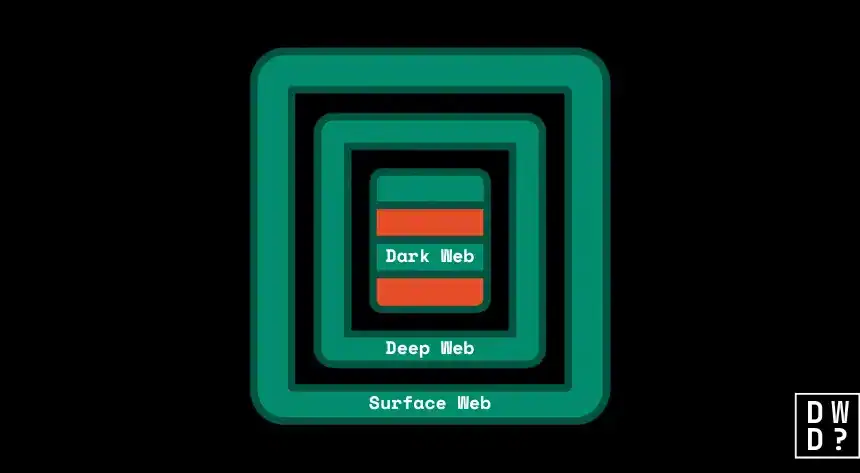
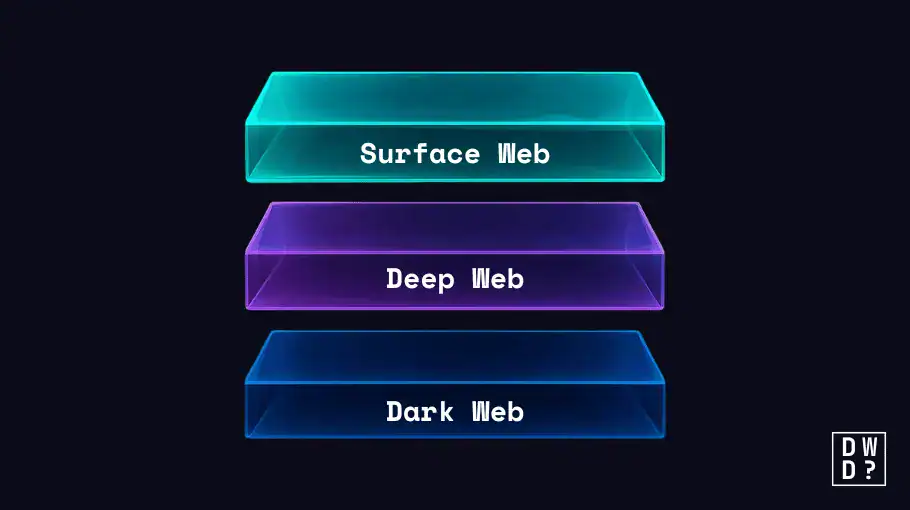
Deep Web vs Dark Web: To understand the internet, you need to know that it has three distinct parts which are the surface web, deep web, and dark web. However, the deep web and dark web are two different terms that are oftentimes confused as one. If you have come across the dark web iceberg diagram before, this is the same idea, minus the exaggerations that usually get attached to it.
In a nutshell, the deep web is any area of the internet that search engines like Google do not see and index. This includes password-protected websites, websites that gate their content behind paywalls, checking bank balance, and even the contents of your emails.
On the other hand, the Dark Web is a hidden area of the internet that requires specific software, like the Tor browser, to access. It offers more security and anonymity for people like whistleblowers and/or cybercriminals.
Deep Web Vs Dark Web ~ Definitions
What is the Deep Web?
The Deep Web makes up the majority of the internet, roughly about 90 to 95%. That range originates with Michael K. Bergman’s 2001 white paper in the Journal of Electronic Publishing, the study that coined the term “deep web” — no rigorous update has been published since, so the figure is best read as an order of magnitude rather than a measurement. This part of the internet holds content which Google or Bing cannot see or index. It comprises almost everything on the internet from password-protected to non-indexed material (such as banking, subscriptions, etc).
An example is when you have to log in to see a page. For instance, when you log in to your G-mail account to check messages, or favorite video streaming site to stream videos, or online bank to check your account history or balance, that’s the deep web at work.
In short, the Deep Web is sensitive and private, mostly everyday content behind logins and paywalls, primarily used for legitimate, securing and storing data. This part of the internet is best for business operations that involve secrecy, credential-protected services, internal corporate systems, and regulatory compliance with data protection standards.
| Pros | Cons |
|---|---|
| Protects personal data from public access | Generates possible data silos |
| Permits private business operations | May contain security flaws |
| Safeguards private company information | Needs strong access constraints |
| Helps regulated data comply with the law |
What is the Dark Web?
The Dark Web is a small, concealed segment of the internet (less than 1% of the entire internet). It is renowned for its anonymity and secured communication. It was not built by criminals, either — the routing technology behind it began as a US Naval Research Laboratory project, and our breakdown of who created the dark web explains how a government privacy tool ended up hosting criminal markets.
Moreso, the Dark Web is a portion of the Deep Web. But, it uses encrypted codes, and software to stay hidden and invisible within the space.
Instead of using popular extensions like “.com” domain addresses (or related), the dark web uses “.onion”, a special-use domain name reserved by the IETF under RFC 7686, rendering them inaccessible through ordinary browsers. Registrars are forbidden from selling .onion names and DNS servers must not answer queries for them, which is why the address only resolves inside Tor.
In short, the Dark Web is part of the internet space and comprises contents that are encrypted and not searchable by traditional search engines like Google, Bing, Safari or Yahoo. It works on encrypted networks like Tor browser or Onion browser (iOS).
These browsers use several routing layers (about three) to encrypt messages and purposefully hide IP addresses, ensuring that your identity is completely hidden and out of reach.
While it has legitimate use, such as secure communication and anonymous journalism, it is the ultimate destination for significant cyberthreats, illicit activities and cybercrime forums. This is because the darknet ensures anonymity and secured communication, hence, people who engage in illicit activities are drawn to it.
In fact, most times, security teams find it very challenging to determine who is responsible for malicious activity due to the dark web’s layered encryption and routing techniques.
| Pros | Cons |
|---|---|
| Enables anonymity for justifiable privacy requirements | Supports illicit marketplaces and activities |
| Permits safe communication in confined spaces | Increases the exposure of organizational threats |
| Supports the right to free speech in areas that are censored | Makes threat intelligence operations more difficult |
| Makes the spread of ransomware easier |
What is the Surface Web?
Any website that traditional search engines like Google and Bing can see, add to their database and index is referred to as the surface web, also known as the visible web or the open web. It represents about 4 – 10% of the total internet. Websites, blogs, online product listings, and even public social media posts fall under this category.
What are the Key Similarities Between Deep Web And Dark Web?
Although, the two have distinct differences, they share several fundamental characteristics, these include:
- Non-Indexed Contents: Neither of their contents are indexed by traditional search engines like Google, Bing, Safari or Yahoo. Both Deep web and Dark Web exist in the invisible part of the internet, unlike Surface web.
- Unique Access: In both cases, you can’t access them directly by searching on Google, they require a unique access mode. For instance, when you want to access the Dark Web you need browsers like Tor, while you need a password to log in on the Deep Web.
- Enhanced Privacy and Security: Both offer a high level of security to users. The dark web is anonymous and built for concealment. On the other hand, the deep web is private, protects and stores users’ data.
- Legitimate Use: Both are legal, and can be used for legitimate use, such as secured banking (deep web) and secure communication (dark web).
- Technological Knowledge and Skills: Although the dark web necessitates more specialist knowledge, both require certain technological knowledge to access correctly.
Risks On Accessing the Dark Web and Deep Web
The internet has various risks associated with it, however, the dark web is more dangerous because it offers total anonymity, making it the perfect space for cybercriminals to carry out illicit activities.
The primary risks involved in Deep web are data breaches and account hacks due to poor secured login portals. However, with strict security measures, the perpetrators can easily be tracked down and held accountable, unlike in the dark web.
The dark web presents sophisticated and evolving threats to individuals and businesses. These include:
- Identity theft: Compromised credentials remain one of the most traded items on dark web forums. The 2026 Verizon Data Breach Investigations Report found credentials showing up as compromised data in 28% of breaches, even though vulnerability exploitation has now overtaken credential abuse as the leading way attackers get in. Corporate login credentials (including employee’s username and password) are frequently offered for sale on the dark web forums, and our dark web statistics for 2026 put the scale of that trade in context.
- Initial Access Brokers: Initial Access Brokers (IABs) offer remote access to infiltrated business networks.
- Brand and Executive Impersonation: Threat actors describe phishing tactics and attacks aimed at an organization’s top personnel. The kits and scripts for this are sold openly, and uncensored AI models like FraudGPT and WormGPT have made the copy much harder to spot — the Coinbase text scam is a good example of what these campaigns look like once they reach a normal person’s phone.
- Challenges with data leakage monitoring: Because dark web connections are encrypted, it is more difficult for enterprises to determine whether sensitive information has been compromised.
- Ransomware distribution networks: Ransomware operators may disseminate viruses, obtain payments, and interact with victims while staying anonymous.
Deep Web Vs Dark Web: Accessibility
The deep web is accessible globally, the key to properly accessing it are essentially the same as those for safely accessing the surface web. However, it’s important to lookout for security flaws and risks on every website you visit. You should make sure that every website you visit operates on a secure architecture that employs HTTPS encryption.
For the dark web, most nations allow users to access it. In fact, big companies like Facebook provide official dark web mirrors of their service to give customers that require anonymity safe access. However, it is illegal to use the dark web for illicit purposes.
The most common way to access the dark web is to download the Tor Browser. You can input a dark web address after you’re on Tor, which typically appears as a random series of letters and digits that ends in “.onion.” Additionally, you can use dark web search engines for well-known topics or obtain compiled lists of onion sites on specific forums.
Mobile works differently. Android users can run Tor Browser or Orbot directly, but there is no official Tor Browser for iOS at all — the Tor Project points iPhone users to Onion Browser instead. Our guide to dark web apps for iOS and Android walks through the setup on both platforms.
Before starting Tor, some people add a VPN, which conceals from your internet provider the fact that you’re using Tor at all. Treat this as a trade-off rather than a straightforward upgrade: the Tor Project does not recommend combining the two unless you understand how to configure both without weakening your anonymity, since a poorly set up VPN can reduce protection rather than add to it.
It’s worth noting that you need deliberate actions and resources to access the dark web; you won’t find them by chance. You won’t naturally stumble upon a dark web marketplace while idly perusing the news or buying goods on Amazon; it just doesn’t happen by accident.
Deep Web Vs Dark Web ~ Key Differences (Comparison Table)
| Deep Web | Dark Web |
|---|---|
| A vast portion of the internet contents that are not indexed by search engines. | A hidden part of the internet space that is accessed via special tools such as Tor. |
| Private part of the internet | Anonymous part of the internet |
| Primarily used for legitimate, secure data storage. | Used for anonymity, secured communication, and most times illegal activities. |
| Best for business operations, confidentiality purposes, credential-protected services, etc. | Best for communications that prioritize privacy, secure journalism, whistleblowing, etc. |
| Contents are not indexed by standard web search-engines but require a login/password to access. | Contents are also not indexed but require specific encrypted browsers to access. |
| Covers about 90% – 95% of the internet space | Covers a lesser portion of the internet space (less than 1%) |
| Major risks include data breaches or account hacks. | Prone to malicious malware, scams, and disturbing content that is often exaggerated online |
| Used standard browsers such as Chrome, Firefox, etc. | Uses special software like Tor, or onion network. |
| Requires login details or a direct URL, since search engines can’t find it. | Uses non-standard URLs for example “.onion”. |
| Its content includes corporate intranets, banking, cloud documents, private emails, and medical records, and more | Contents: Forums, whistleblowing, marketplaces for narcotics, stolen data, and hacking tools and illegal cyber content. |
| Legal to access in all countries | Legal in most countries. However, illicit activities are illegal |
| Traceability: Medium to Hard | Traceability: Very Hard |
Dark Web Monitoring – Why is it Important?
It’s 2026, dark web monitoring shouldn’t be an option, especially for businesses and companies, rather it’s a necessity to prove sufficient security measures. Dark web monitoring assists firms in meeting these security measures by enabling early breach discovery, supporting risk assessment standards, and displaying the proactive security posture that auditors and regulators expect.
For individuals, the starting point costs nothing. Have I Been Pwned will tell you which of your email addresses have already turned up in a known breach. Paid services go further by watching forums and paste sites continuously and alerting you when fresh records appear — our reviews of Aura and Norton cover what each one actually detects and how quickly the alerts land.
In summary
The deep web vs dark web debate comes down to privacy vs anonymity. The deep web includes anything online that search engines cannot index, such as contents behind passwords or blacklisted by Google. Every time you access Gmail or your business intranet, you are on the deep web. The dark web, on the other hand, is a subset of the deep web that is purposefully concealed and only accessible through specialized software such as the Tor browser.
The best way to reduce the risk that the dark web poses to an organization is to actively look out for employees whose data have been compromised before it is used as a weapon. You can also practice patching by monitoring and determining which vulnerabilities are being actively discussed and exploited on the dark web.
Frequently Asked Questions (FAQs)
Will it be criminal to use the Dark Web in 2026?
No, access to the Dark Web with a browser such as Tor is not illegal in most countries. It is a valid privacy instrument, and applied by journalists, whistleblowers, and individuals residing under censorship.
Nevertheless, committing an illegal act, i.e., buying stolen information, or breaking the law by acquiring an illegal goods, is a crime irrespective of the section of the internet you find yourself in.
Can I be tracked down on the Dark Web?
Yes. Although Dark web is quite anonymous as it bounces your signal across three encryption layers, it is not a hundred percent foolproof.
Can my data be present in the Dark Web even though I haven’t used it?
Absolutely. Third-party data breaches are the likely outcome of your data going to the Dark Web. For instance, when a company that you use is hacked, the databases stolen are frequently sold on darknet forums. The 2021 T-Mobile breach is the clearest example: roughly 76 million people had Social Security numbers and driver’s license details exposed, and almost none of them had ever opened Tor. That is why even those people who do not use the Tor browser should monitor the Dark Web.
Should I use a VPN with Tor in 2026?
This is more contested than most guides admit. Connecting to a VPN before Tor — properly called Tor over VPN, not VPN over Tor — does hide your Tor use from your Internet Service Provider, which matters in places where using Tor at all draws attention. But the Tor Project’s own position is that it doesn’t recommend the combination unless you’re an advanced user who can configure both without compromising your privacy, because in practice it can reduce anonymity or break Tor’s protections. If your only goal is hiding Tor use from an ISP, Tor’s built-in bridges are designed for exactly that.