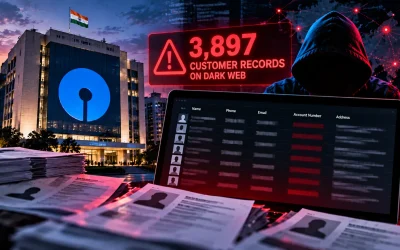
On September 7, 2026, at around 6:16 PM, a dark web intelligence monitoring account called @DailyDarkWeb posted a short alert. Country: India. Organization: ValueFirst. A shortened link. That was it.
No database size. No threat actor name. No ransom demand. No sample data. Just a company name attached to a dark web monitoring flag, with 15 views recorded at the time of first reporting.
That kind of minimal listing could mean a lot of things or almost nothing at all. Dark web intelligence accounts flag hundreds of claims every week. Many turn out to be recycled data from old breaches, exaggerated claims, or listings pointing to third-party information that got loosely attributed to a recognizable name.
But ValueFirst is not just any company. And that’s exactly why a bare-minimum alert about this particular organization deserves a closer look than most one-line dark web mentions.
Quick answer: On September 7, 2026, dark web intelligence monitor @DailyDarkWeb posted a brief alert naming ValueFirst in India alongside a shortened link. No data details, no threat actor identity, and no confirmed breach have been published. ValueFirst is a CPaaS (Communications Platform as a Service) provider, now part of Tanla Platforms, that routes SMS, WhatsApp, and OTP messages for banking, e-commerce, and enterprise clients across India and internationally. No breach has been confirmed. The alert has not been independently verified. But the nature of what this company handles makes even an unverified listing significant enough to report carefully.
First: Who Is ValueFirst?
ValueFirst was founded in 2003 and is headquartered in Gurugram, Haryana. It’s a CPaaS company, Communications Platform as a Service, which is the business of providing the infrastructure that lets other companies send messages to their customers. SMS, WhatsApp, email, voice calls, RCS, Truecaller notifications, and OTP codes for login verification: all of this runs through the pipes that CPaaS providers like ValueFirst build and maintain.
The company was acquired by Twilio in 2021, then acquired again by Tanla Platforms Limited, India’s largest cloud communications company, listed on both the NSE and BSE, in June 2023 for approximately $42 million. Today, ValueFirst operates as part of Tanla, serving banks, e-commerce companies, logistics providers, and retail enterprises across India, Indonesia, Saudi Arabia, and the UAE.
Its clients connect to ValueFirst through APIs, the same integration points that power the “Your OTP is 847291” messages that land on millions of Indian phones every day for logging into bank accounts, verifying UPI payments, resetting passwords, and confirming transactions. ValueFirst’s partners include Salesforce, CleverTap, and MoEngage, which means its data pipelines touch CRM systems that can hold detailed customer profiles far beyond a simple phone number.
That context is the reason the dark web alert matters. Understanding what ValueFirst does is what turns a one-line listing into something worth examining. This is the same principle we covered in our piece on how supply chain attacks use third-party vendors as the entry point: the target isn’t always the company you’re thinking of. Sometimes it’s the messaging layer underneath.
What the Alert Actually Says and What It Doesn’t
The alert from @DailyDarkWeb is extremely short. It identifies the country as India and the company as ValueFirst. It includes a link, presumably to additional material on the underlying platform, but the content of that link has not been publicly shared in full.
That’s the entirety of the publicly available information from the original post.
There is no description of what data was allegedly exposed. There is no claim about the method of access, the volume of records, the date of any intrusion, or whether any information was offered for sale, published freely, or held for ransom. The listing doesn’t name a threat actor, doesn’t reference a ransomware group, and doesn’t include a sample dataset.
This matters because the absence of detail can mean multiple things, and treating a minimal dark web listing as confirmed evidence of a breach would be wrong.
Dark web monitoring accounts like @DailyDarkWeb aggregate signals from underground forums, leak sites, and Telegram channels. A company name appearing in their feed doesn’t automatically mean that company was hacked. It could mean that information associated with that company’s name appeared somewhere. That information could be:
- Data from a genuine breach of ValueFirst’s own systems
- Data from a connected third party that was mislabeled or loosely attributed
- Older breach data being recycled and re-listed
- Credentials harvested from employee devices by infostealer malware, unrelated to any server compromise
- A fabricated or exaggerated claim from a threat actor with no real data to back it up
Determining which of those possibilities applies requires evidence that isn’t in the public domain yet. Neither ValueFirst nor Tanla Platforms had issued a public statement at the time of writing.
Why a Messaging Platform Is a Different Kind of Target
Most data breach coverage focuses on names, addresses, and identity information. That’s the obvious risk. But a CPaaS provider sits at a different point in the data chain, and an exposure there carries distinct risks that aren’t as immediately obvious.
ValueFirst routes OTP messages. In India, OTPs delivered by SMS are the dominant second-factor for accessing bank accounts, confirming UPI payments, logging into investment platforms, and resetting passwords. India processed over 18 billion UPI transactions a month in 2026. A significant share of those transactions touch an OTP step somewhere in the flow.
If an attacker gains access to a messaging platform’s infrastructure, the most serious risk isn’t necessarily reading stored data; it’s the potential to intercept, replay, or redirect messages in motion. An OTP that goes to the wrong destination doesn’t need to come from a cloned SIM card if someone already has access to the system generating and routing the message.
This is why India has seen such a sharp rise in SMS-based banking fraud, a 146% increase in incidents between the second half of 2025 and first half of 2026 compared to the same period the previous year. India’s national cybercrime helpline (1930) and the National Cyber Crime Reporting Portal have seen corresponding increases in fraud reports tied to spoofed or intercepted OTPs.
A compromised messaging provider wouldn’t just expose the data of one company. It would create a potential window into the communications of every enterprise client whose messages run through that infrastructure. That cascade effect is what makes CPaaS companies attractive targets and why an unverified alert still warrants serious attention from anyone working in Indian fintech or e-commerce.
ValueFirst’s Corporate History Adds a Layer of Complexity
There’s something else worth understanding here: ValueFirst’s ownership has changed hands twice in four years.
Twilio, the US-based cloud communications giant, acquired ValueFirst in 2021. Tanla Platforms then acquired ValueFirst from Twilio in June 2023. Each acquisition transfers not just the business operations but also the data systems, integrations, legacy infrastructure, and any security configurations the previous owner had in place.
Acquisitions are a known security risk window. When a company changes ownership, integrating disparate security architectures, access controls, API credentials, and compliance frameworks takes time. Stale credentials, forgotten integrations, and mismatched access policies can all survive an acquisition longer than they should. This is not an accusation that any specific gap exists at ValueFirst. It’s a documented pattern across corporate acquisitions generally.
The fact that ValueFirst was previously part of Twilio is also relevant in another way. Twilio itself experienced a significant breach in 2022, when attackers used phishing to steal employee credentials and gain access to internal tools, ultimately affecting 163 of Twilio’s clients. ValueFirst’s acquisition by Tanla means it’s no longer under Twilio’s umbrella, but customer data and API integrations that pre-date the transfer may still carry historical exposure windows worth examining.
For enterprises in India using ValueFirst’s APIs for their own customer communications, understanding the data provenance, what customer information sits where, under which system, with which access controls, matters now more than ever.
Frequently Asked Questions
Was ValueFirst hacked?
No confirmed breach has been announced. A dark web intelligence monitoring account named ValueFirst in an alert on September 7, 2026. No data details, threat actor, or sample information have been publicly confirmed.
What is ValueFirst?
ValueFirst is an India-based CPaaS provider, part of Tanla Platforms Limited, that delivers SMS, WhatsApp, RCS, email, and OTP messages for enterprise clients in banking, e-commerce, logistics, and retail. It was previously owned by Twilio before Tanla acquired it in June 2023.
Why does a CPaaS breach matter more than a standard data breach?
Because CPaaS providers route the OTP messages used to verify bank logins and UPI payments. A compromise of messaging infrastructure could enable OTP interception, spoofed business SMS messages, and social engineering attacks that are far harder to detect than a leaked email and password combination.
What should I do if I’m an Indian consumer concerned about this?
Watch for unexpected OTPs, calls from “banks” that already know your details, and small unauthorized transactions. Report fraud to cybercrime.gov.in or call 1930. Enable transaction alerts on all bank accounts and UPI apps.
What should enterprise clients of ValueFirst do?
Audit active API credentials, check authentication logs for anomalous access, review what customer data fields pass through the ValueFirst integration, and consider rotating API keys as a precautionary step.