On any given day about three million people use Tor, and the vast majority of them never load a single .onion address. Some of them are reading news that has been blocked by their government, some are reporters in communication with sources, and a small number are purchasing drugs. They all use the same network, and in most countries using that network is entirely lawful.
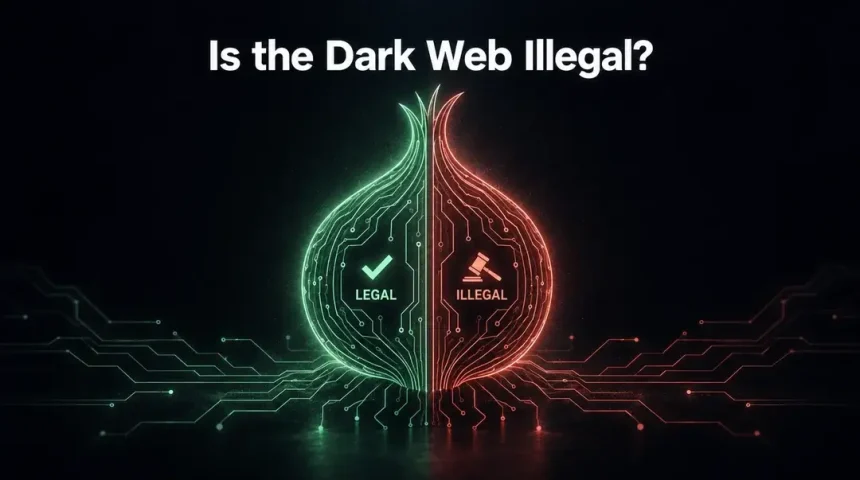
Simply put, the dark web is not illegal. It is legal in the United States, the United Kingdom, Canada, Australia and almost all EU countries to download the Tor Browser. Opening an onion site by itself is not a crime. The legal risk arises from the actions you take after the page has loaded and from the country you are in at the time.
It takes ten seconds to find that answer, so we won’t stop there. If you compare the countries that ban Tor with those where dark web crime actually centres, a rather odd pattern emerges. The strictest regulations and the largest criminal markets are often found in the same places. Countries with the freest rules actually show higher levels of illicit onion use per user, not lower ones. Once you notice this, the question of whether it’s illegal stops being a simple yes or no and starts to look like a map, one that tells us a great deal about who the law is really intended to target.
Below, we look at the legal status in each country, the research into how much of the dark web is criminal, the particular actions that lead to ordinary people being charged, the way police manage to locate buyers, and whether using Tor can count against you. If you are new to the subject, our guide to what the dark web is covers the basics first.
The legal status, country by country
The term “dark web” generally refers to Tor onion services, even though I2P and Freenet work on similar principles and are treated the same way by courts. No democratic country has passed a law making it a crime to use Tor. The difference lies in how far a government blocks the network and whether it punishes people for getting around that block.
| Country | Using Tor | What actually gets enforced |
|---|---|---|
| United States | Legal | Buying or selling contraband, CSAM, fraud, hacking. Tor itself grew out of US Naval Research Laboratory work |
| United Kingdom | Legal | Same acts, plus possession of material useful for terrorism under the Terrorism Act |
| Germany, France, Netherlands | Legal | Drug, weapon and data offences. Germany ranks second worldwide in daily Tor users |
| Canada, Australia | Legal | Content and transaction offences, not the tool |
| Russia | Network blocked since December 2021 | Fines since September 2025 for deliberately searching “extremist” material, with VPN or proxy use treated as an aggravating factor |
| Belarus | Anonymisers banned since 2015 | Access to blocked resources through circumvention tools |
| China | Blocked by the national firewall | Unapproved international connections, enforced sporadically with fines |
| Iran, Turkmenistan | Heavily blocked | Blocking first, punishment case by case |
Two entries from that table are worth examining in more detail.
The first is the number of users. According to Tor Metrics, the United States had approximately 609,000 directly connecting users per day over the 30 days ending 9 October 2026, Germany had about 305,000 and the UK around 173,000. The highest usage is found in countries where Tor is openly legal.
The second is Russia. In July 2025 the Duma approved Article 13.53 of the Administrative Code, imposing fines of 3,000 to 5,000 rubles (about $38 to $64) on individuals who knowingly search for and access material on the government’s extremist list, according to Human Rights Watch. The list is wide-ranging and includes Alexei Navalny’s Anti-Corruption Foundation and what Russian courts call the “international LGBT movement”. Russia had already blocked the Tor protocols in December 2021, several months before the invasion of Ukraine. The fine is minor, but the message isn’t, since it turns the act of looking up information into an offence.
Keep Russia in mind, because it returns in the next section in a way most articles on this subject overlook.
The map where legality runs backwards
If banning Tor had led to a reduction in dark web crime, the countries with the most restrictive measures would have the smallest criminal markets. The data shows the opposite.
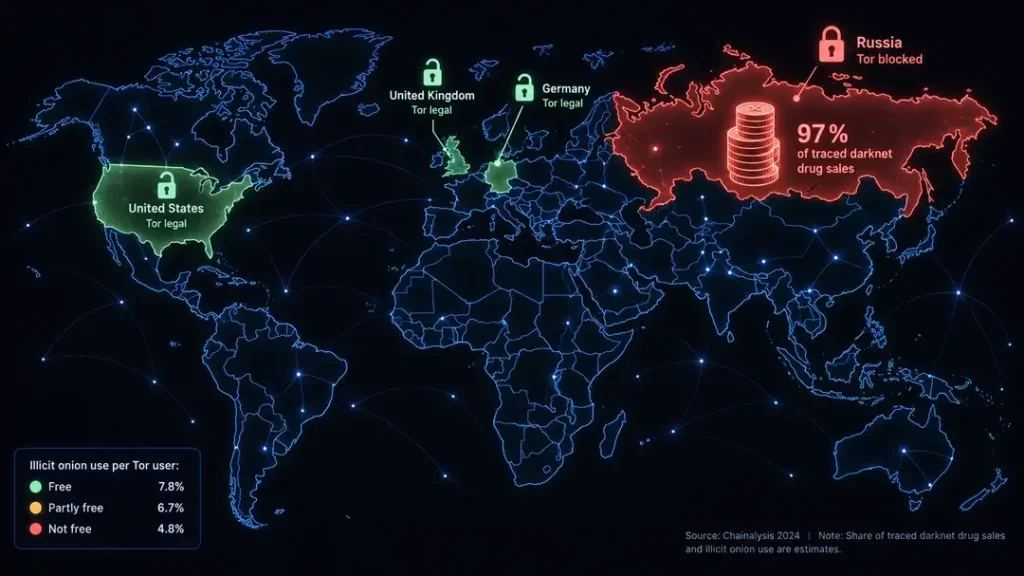
Start with the money. Chainalysis has estimated that darknet markets took in nearly $2.6 billion in crypto in 2025, up from approximately $2 billion the year before. TRM Labs, a competing blockchain analytics firm, found that Russian-language markets made up more than 97% of the illicit drug sales volume it could trace in bitcoin and TRON in 2024. Its 2026 report shows that inflows to those markets reached $1.6 billion in 2025, a rise of about 20% on the previous year’s $1.3 billion.
The largest market in the world is Kraken (no connection with the US crypto exchange). In 2024 it earned approximately $737 million, an increase of 68%, and overtook its competitor Mega. According to the UN’s 2026 World Drug Report, the four biggest markets in 2025 were Kraken, OMG, Mega and Blacksprut, all of which cater to Russian speakers. Our tracker of dark web marketplaces in 2026 shows which are still online.
The country that blocks Tor at the network level, fines people for searching the wrong content and prohibits the promotion of VPNs also hosts the largest drug economy on the dark web. In 2024 TRM identified around 20 Russian-language markets, and only four of these disappeared that year. No major Russian-language market has been dismantled since German police shut down Hydra in April 2022. TRM’s own explanation points to a low likelihood of action by Russian law enforcement, a dead drop delivery method, locally produced synthetic drugs and cheap precursor chemicals from China.
Now consider the user’s side. In a 2020 study published in PNAS, Eric Jardine and his colleagues used data from Tor entry nodes to estimate the proportion of users who access onion services (sites that lean heavily towards illicit content) compared with regular websites. On an average day in an average country, approximately 6.7% of Tor users connected to onion services. Broken down by Freedom House rating, the figure was 7.8% in countries classified as “free”, 6.7% in those rated “partly free” and 4.8% in those deemed “not free”.
If you consider the two findings together, the entire picture changes. In repressive states a greater proportion of Tor traffic consists of people reaching the regular web they are not permitted to see. In open democracies, where there is no need to use Tor to read the BBC, a larger portion of the remaining traffic goes to hidden services. Yet the largest criminal market economy operates in a country where Tor is officially blocked.
For anyone who believes that the legal status of a tool determines people’s behaviour, the conclusion is unpleasant. Russia’s restrictions target the political use of anonymity (a dissident opening a banned site, for example) far more than its commercial use. Western countries, in contrast, keep the tool legal and spend their enforcement resources on the transactions. In both situations, asking whether the dark web is illegal is the wrong question. The better question is what each government has chosen to pursue.
The government that funds Tor also hunts its markets
One fact settles the question of legality in the United States more firmly than any statute. The American government funds a large part of Tor.
The Form 990 filed by the Tor Project for the fiscal year 2023 to 2024 shows revenue of about $7.29 million. Government grants accounted for 35%, or approximately $2.56 million, most of which came from the State Department’s Bureau of Democracy, Human Rights, and Labor. Sida, Sweden’s development agency, was the biggest contributor among non-US governments. Two years earlier, government funding had been 53.5% of the total. In 2015, US government sources covered around 85% of the budget, a proportion Tor has gradually been reducing.
At the same time, the Justice Department runs JCODE, a task force set up specifically to dismantle darknet drug markets. Some people read this as hypocrisy, but it is more accurately a reflection of the government’s legal approach. It funds the road and prosecutes the smugglers who drive on it, much as it builds highways and still runs traffic stops.
The list of mainstream organisations that run their own onion addresses makes the same point.
- In 2014 Facebook introduced an onion version.
- ProPublica did so in 2016 and The New York Times in 2017.
- In 2019 the BBC opened one so that people in countries with censorship could access its World Service.
- The CIA launched an onion site the same year, mainly so people abroad could contact it safely.
- A large number of newsrooms use SecureDrop, an onion-based system that lets them receive documents from whistleblowers.
None of these organisations would attach their name to something they believed was illegal to visit. A CIA onion address is about as clear an indication as you will find that using Tor is lawful in the United States.
How much of it is actually criminal
If you ask two researchers the same question you will get two figures, both plausible, because they measure different things. Our roundup of dark web statistics shows how widely the estimates vary.
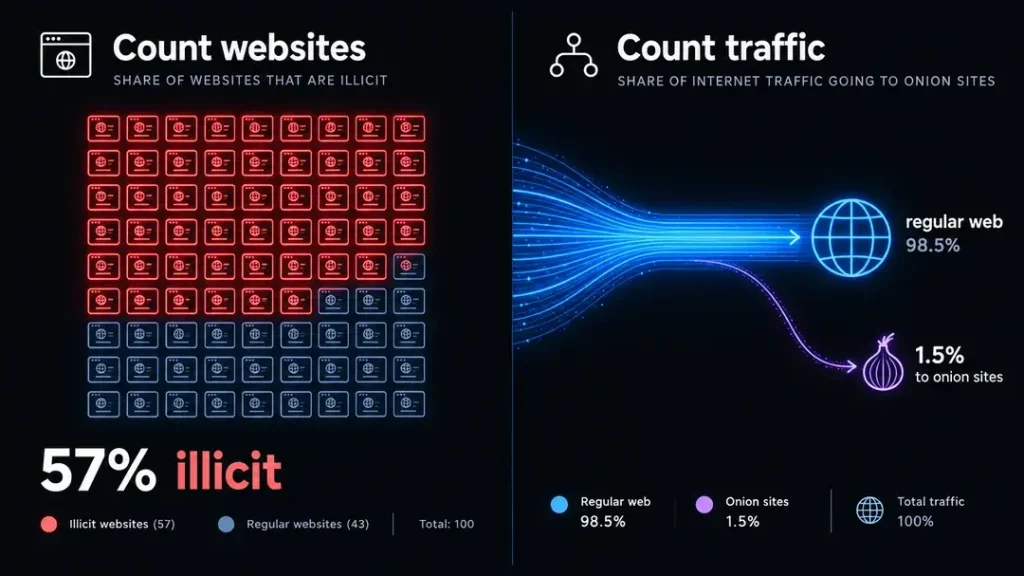
Count websites and the dark web looks mostly criminal. In 2016, Daniel Moore and Thomas Rid from King’s College London crawled onion services starting from the search engines Ahmia and Onion City. They recorded 5,205 live sites and classified the content of 2,723 of them. Of these, 1,547 (around 57%) contained illicit material. In the same year, the threat intelligence companies Intelliagg and Darksum mapped 29,532 onion services, found that only 46% were accessible, and estimated the proportion of illegal content at 48% using automated tools and at 68% when a sample of 1,200 was examined by hand.
Count traffic instead and the picture looks very different. In 2014 Gareth Owen from the University of Portsmouth ran relays inside the network and discovered that only about 1.5% of Tor traffic actually went to onion sites. The rest was normal browsing routed through Tor for privacy. He came across approximately 80,000 onion services, most of which appeared once and then disappeared.
There is also a hidden drawback with counting sites. In 2016 the OnionScan project pointed out that one scammer could clone a market page dozens of times, and each copy would appear as a separate “illegal site” in a crawl. A forum with 50,000 members and a phishing clone with no visitors count the same.
Market instability matters for the legal question too. According to the UN Office on Drugs and Crime, darknet markets between 2010 and 2023 lasted an average of one year and four months. Most of them close as a result of exit scams, voluntary shutdowns, hacks or police action. Abacus, which reportedly handled over 70% of bitcoin-based darknet market sales for buyers in the West, closed in July 2025 through an exit scam, after which its operators vanished with the customers’ funds.
A fair summary, then. Most onion sites that a crawler can locate lean towards illegal content. Most people who use Tor do not visit onion sites. Both statements are true, and neither makes the network itself illegal.
Where ordinary users cross the line
In places where Tor is permitted by law, the law does not care which network carried your traffic. It looks at the same things it looks at on the regular web. The only difference is that the dark web puts a number of serious offences just one click away, and some of them catch people who thought they were doing nothing wrong.
Buying anything illegal, even once. A single gram of cocaine ordered from a market is a drug offence, and since it was sent into the country by post it may also amount to an importation offence, a charge that usually carries more severe penalties than simple possession. In the United States, ordering through the mail can bring federal rather than state charges. Losing your money to a scammer does not help you, and in many places an attempted purchase can still lead to a charge.
Child sexual abuse material. This is the only situation in which simply looking can amount to a crime. In the United States and the United Kingdom, viewing such material can be treated as receiving or making a copy, since the images end up in your browser’s cache. There is no curiosity defence, as cases like this one in Hull show. If you come across it, close the page and report it to the NCMEC CyberTipline in the US or the Internet Watch Foundation in the UK.
Stolen data and card dumps. Buying credit card numbers, login details or identity kits is fraud. In the United States this falls under the access device fraud statute, 18 U.S.C. 1029, which makes it an offence to possess fifteen or more stolen card numbers or credentials with intent to defraud. Downloading a leaked customer database just to have a look sits in a grey area that depends on what you do with it and where you live. Security researchers usually work under written policies for this reason. If your own details are the ones being traded, here is what to do if your information is on the dark web.
Hiring someone. Hacking for hire, DDoS services and the well-known murder-for-hire websites are in almost all cases scams (the red room myth belongs in the same category). People have still been taken to court, because paying someone to commit a crime is solicitation or conspiracy whether or not the service was genuine.
Moving the money. Using a mixer to conceal where funds came from can amount to money laundering. The United States has finalised the forfeiture of over $400 million connected with Helix, a mixer that served darknet markets, and the person who ran it was sent to prison. Mixing did not save the Empire Market operators either.
Reading and collecting, depending on where you are. In the United States, reading a forum is protected. In the UK, collecting a document likely to be useful to a terrorist is itself an offence. In Russia, deliberately looking up anything on the extremist list is now punishable, and that list includes mainstream opposition material.
Almost everywhere in the democratic world, it is legal to browse onion versions of news websites, use encrypted email, read privacy discussion forums, study how markets function and look at a market page without making a purchase. The risk with each of these comes not from the act itself but from what you might stumble across. Our guide on how to access the dark web safely covers how to keep that risk low.
How police actually find buyers
It is generally thought that Tor makes you invisible, so the only ones who get caught are careless kingpins. The arrest figures contradict this and show precisely how the risk works.
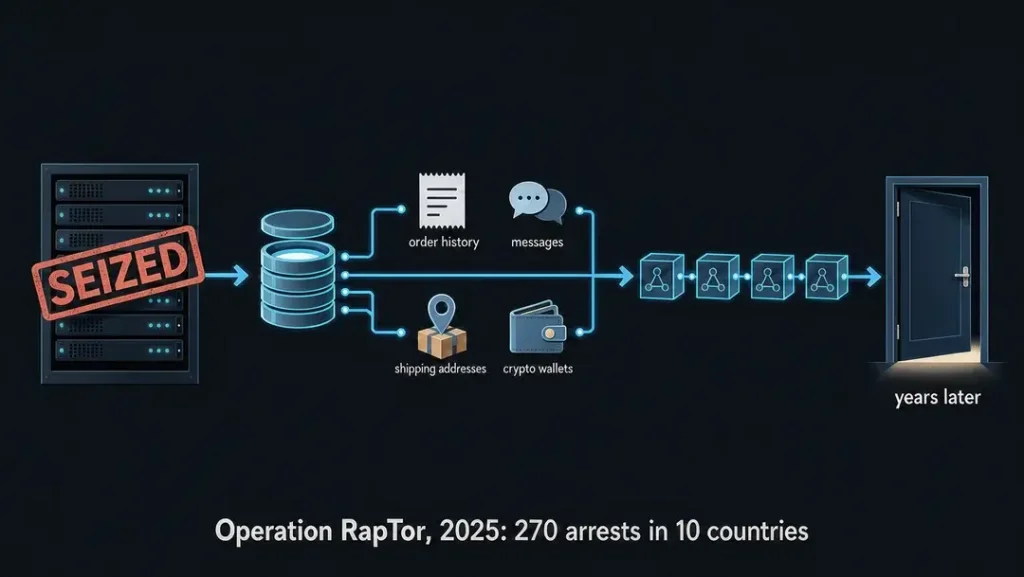
In May 2025 Europol announced Operation RapTor, which resulted in 270 arrests in ten countries. The figures are revealing. The United States had 130 arrests, Germany 42, the United Kingdom 37, France 29 and South Korea 19, with smaller numbers in the Netherlands, Austria, Brazil, Spain and Switzerland. The authorities also seized more than €184 million in cash and crypto, over two tonnes of drugs and more than 180 firearms.
None of the 270 were caught by breaking Tor. They were identified from data obtained on four markets the police had already seized, namely Nemesis, Tor2Door, Bohemia and Kingdom Markets. RapTor followed Operation SpecTor in 2023 (288 arrests) and DisrupTor in 2020 (179 arrests). Europol puts the pattern plainly. Taking down a platform marks the beginning of the investigation, not its conclusion.
The one thing many dark web users fail to realise is that when police take over a market, they obtain its database. That database may contain order histories, private messages, shipping addresses typed without encryption, and wallet addresses that can be traced on the blockchain to an exchange account with a real name attached. A purchase made in 2022 can lead to a knock on the door in 2025. The 40-year sentence for Empire Market’s Raheim Hamilton shows how long these investigations can run.
One month after RapTor, German police carried out Operation Deep Sentinel against Archetyp Market. Archetyp had been operating for more than five years and had over 600,000 users, some 3,200 vendors and approximately 17,000 listings. Eurojust estimated the total volume of trade at no less than €250 million. About 300 officers took part in the June 2025 action days, the German administrator was arrested in Spain and €7.8 million in assets was seized. Archetyp was also one of the very few markets that still permitted fentanyl listings.
What followed was just as one would expect. The Global Initiative Against Transnational Organized Crime found that within 48 hours, scam relaunches calling themselves “Archetyp V2” had appeared. Fake vendors began impersonating well-known sellers to collect “refunds”, and displaced users poured into smaller markets until those crashed too.
The full legal situation for someone who wants to make a purchase has three aspects. The purchase itself is illegal. The probability of being prosecuted over any one order is small. And that probability does not expire, because every seized server produces a list of leads that investigators keep pursuing for years.
Can using Tor count as evidence against you?
The fact that something is legally permissible does not mean it is harmless in court. The record here is mixed, and it is important to know where the boundary has been set.
In 2009 the US Justice Department asked the Sentencing Commission to amend the federal guidelines so that using any technology to conceal a defendant’s identity or location “ordinarily indicates sophisticated means”. That finding adds two levels to a fraud sentence, which could mean extra months or years in prison. The Electronic Frontier Foundation sent technologist Seth Schoen to give evidence against the proposal, arguing that running a proxy takes about the same skill as using Microsoft Word and that millions of people do it for normal reasons. The Commission declined to adopt the proposal at that time.
That did not keep Tor out of courtrooms. Prosecutors regularly include a defendant’s use of Tor in charging documents and sentencing memos as part of the story of concealment. In the Silk Road case, the government’s sentencing letter highlighted that Ross Ulbricht had hosted the site on Tor so users could trade beyond the reach of the police, and asked for a sentence that would discourage the next person to set up such a market. He was given a life sentence. When judges treat Tor as background alongside the actual crimes, it can make a defendant appear more calculating.
Russia went a step further and wrote it into law. Under the 2025 amendments, using a VPN or similar tool to access extremist material is an aggravating circumstance. Digital rights lawyers in Russia have warned that simply having a VPN on your phone could lead to a closer look.
On the investigative side, the FBI’s handling of Playpen showed how far agencies are willing to go once they control a hidden service. Playpen was a child abuse website hosted on Tor, which the FBI seized in 2015 and kept running for approximately two weeks. Agents used a hacking tool to obtain the real IP addresses of visitors, and the prosecutions that followed led to years of litigation over whether a single warrant could permit searches of computers anywhere in the world.
For someone doing nothing wrong, the takeaway is reassuring. In the United States, the United Kingdom and the European Union there is no offence of using Tor and no legal assumption that someone who uses it is up to something. The risk only becomes significant when it is linked to an underlying crime.
What about running part of the network?
The network relies on volunteers to operate relays, and their legal status is a good indication of how the law views the network as a whole.
A middle relay or a bridge passes encrypted traffic it cannot read, and the people who operate them run very little practical risk in most democratic countries. The same applies to Snowflake, the browser extension that lets volunteers turn their home connection into a temporary bridge for users in Russia and Iran.
Exit relays are different, since traffic leaves the Tor network from your IP address. If somebody uses that exit to harass, defraud or download abusive material, the complaint ends up directed at you. In most cases the matter is settled by a letter explaining that the address is a Tor exit. Not always, though. In 2014 an Austrian court convicted William Weber, an exit operator, after illicit images had passed through his relay. The Tor community regarded the ruling as a warning about countries without clear protection for intermediaries. In 2018 German police raided the homes of board members of Zwiebelfreunde, a nonprofit that raises funds for Tor, over a case that had nothing to do with them. A Munich court later ruled those searches unlawful.
In the United States, legal scholars and the EFF generally point to the same safe harbour that shields internet service providers from liability for what their customers send. As far as public records show, no US exit operator has ever been convicted simply because traffic passed through their relay. The standard advice is to run an exit on a host that knows what you are doing, never on your home connection, and to keep the EFF’s legal FAQ for Tor relay operators to hand.
Three questions that answer it for you
Since legality depends on place and action rather than on the network, a better test than “is the dark web illegal?” is to ask yourself three questions before opening the Tor Browser.
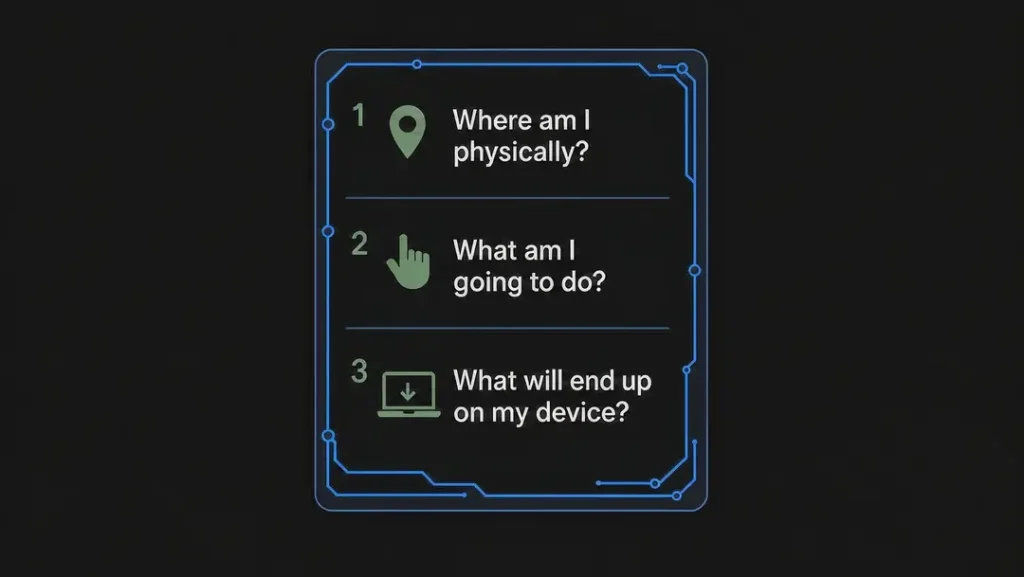
- Where am I physically? The law that applies is that of the country where your body is, not the country where the server is. A tourist in Minsk or Moscow is subject to different rules from the same person at home in Berlin.
- What am I going to do? Reading, researching and communicating privately are legal throughout the democratic world. Buying, selling, hiring or moving money for an illegal purpose is an offence on any network.
- What will end up on my device? Files, cached images and downloaded databases can turn a single visit into possession. If you come across anything you couldn’t account for to a judge, close it, clear it and report it where appropriate.
The story governments often tell about the dark web is that it is lawless. The evidence points to a different conclusion. The largest criminal markets are found where enforcement is weakest, not where Tor is legal. The greatest number of legal users are found in the freest countries. Police generally catch people not by breaking anonymity but through seized databases and blockchain records, and the same government that funds the software goes on to prosecute those who misuse it.
The network is legal throughout most of the world, but what you send across it is another matter, and the law has a long memory for that.
The information in this article is general and should not be taken as legal advice. Laws vary from country to country and change over time, so consult a lawyer in your own jurisdiction about any particular situation.
Sources
- Tor Metrics users, 2026 summary
- Jardine et al., The potential harms of the Tor anonymity network cluster disproportionately in free countries (PNAS 2020)
- Chainalysis 2026 Crypto Crime Report coverage, darknet markets at $2.6B
- KoinX summary of Chainalysis and TRM 2026 data
- TRM Labs, illicit drug sales in 2024
- UNODC World Drug Report 2026, darknet markets
- Human Rights Watch on Russia’s search law
- Meduza on Article 13.53
- AP via PBS on the Russian law
- Tor Project, censorship in Russia, Iran, Turkmenistan
- Tor Project financials 2023 to 2024
- Tor Project 2018 and 2019 finances
- Moore and Rid study coverage (Motherboard)
- Intelliagg and Darksum Deeplight report (SC Media)
- OnionScan report, April 2016
- Owen, Portsmouth study coverage (ITPro)
- Operation RapTor arrests by country
- Operation RapTor and earlier operations (teiss)
- Eurojust on the Archetyp takedown
- Global Initiative, An archetypal drug market
- EFF on the 2009 proxy sentencing proposal
- Seth Schoen testimony to the US Sentencing Commission
- Government sentencing submission, United States v. Ulbricht