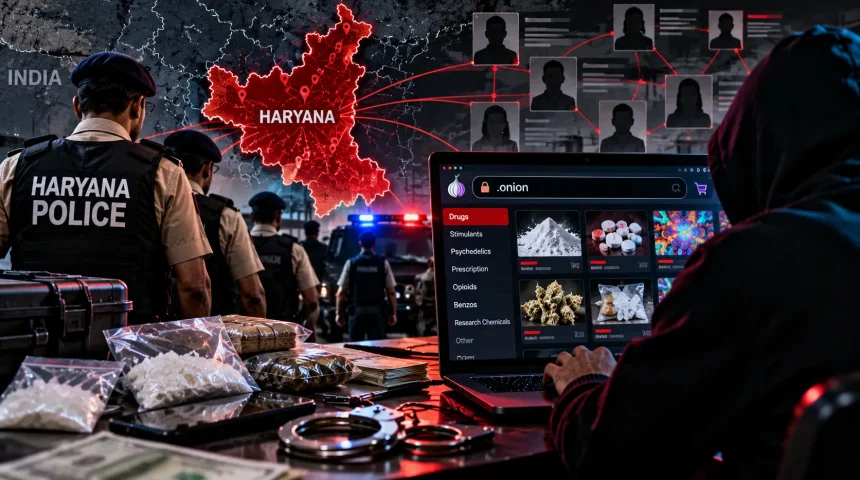
Haryana, India, has identified 71 drug cartels and is developing a specialized cyber unit to investigate dark web drug trafficking and cryptocurrency transactions. Between January and September 2026, police registered 3,809 NDPS cases (up 40%) and arrested 6,824 accused. Heroin seizures nearly doubled, cocaine seizures nearly tripled, and property attachments jumped 229%. Plans include deploying Chainalysis Reactor for blockchain forensics and integrating AI-driven financial surveillance.
71 Cartels Named: Action Is Underway
At the meeting, Kumar confirmed that 71 drug cartels have been identified across Haryana and that police are actively working to dismantle their networks. The identification alone is significant. Mapping an organized drug network well enough to name it and document its structure is the foundational step before prosecution.
Enforcement numbers from January to September 2026 show how much pressure is already being applied. The state registered 3,809 cases under the Narcotic Drugs and Psychotropic Substances (NDPS) Act, a 39.93% increase over the 2,722 cases in the same period last year. Arrests rose 26.53%, from 5,393 to 6,824 individuals.
Those headline numbers are significant, but the breakdown by quantity category matters more for understanding the nature of the threat. Cases involving intermediate drug quantities rose 50.72%, from 1,887 to 2,844. Cases involving commercial quantities increased from 346 to 380. The rise in commercial-quantity cases suggests organized trafficking rather than individual users driving a growing share of enforcement activity.
The Drugs Being Seized
The seizure figures are where the scale of the problem becomes most concrete.
Heroin seizures rose 96.16%, from 43.176 kg to 84.695 kg, essentially doubling in nine months. Opium went from 235.550 kg to 430.326 kg. Cocaine seizures climbed from 1,004.76 grams to 2,958.757 grams, nearly tripling.
The heroin figure is particularly significant given the regional context. Haryana’s proximity to Punjab, a state with documented cross-border supply routes for heroin and its role as a transit corridor to Delhi and other major population centers, makes the seizure trend an indicator of trafficking routes, not just local demand.
For comparison, the Canadian dark web drug network we covered in October, Project Ghostwire’s Icy White North, held roughly 5.5 kg of fentanyl representing an estimated 50,000 fatal doses. Haryana’s heroin seizures operate at a different order of magnitude. The domestic Indian opioid supply chain, fed by Pakistan border routes and internal diversion of pharmaceutical opioids, generates seizure numbers that reflect a much larger trafficking volume.
The Dark Web and Cryptocurrency Challenge
Here’s the structural shift Haryana’s narcotics bureau is building to address. Traditional drug enforcement follows cash. Cash moves through couriers, informal banking networks, or property transactions, all of which leave traces that financial investigators can follow.
Digital drug operations don’t work that way. A HSNCB cyber investigator quoted in Outlook India’s earlier reporting put it directly: “Drug money isn’t moving in cash anymore. It’s buried in cryptocurrency, micro-transactions, and encrypted wallets.”
Haryana’s planned specialized cyber unit is designed around three specific functions: monitoring dark web markets where drugs are advertised and sold, tracking encrypted drug sales through peer-to-peer supply chains, and infiltrating the financial networks that support those operations.
The planned tool for this last function is Chainalysis Reactor, a professional blockchain forensics platform used by law enforcement agencies worldwide. Chainalysis technology traces cryptocurrency transactions by mapping wallet addresses, identifying mixing and layering patterns, and connecting on-chain movement to real-world identities where exchange records exist. This is the same class of blockchain analytics that helped trace transactions in international dark web drug cases, including the Uttarakhand-origin case in the US, where authorities seized $150 million in cryptocurrency from a network operating on Silk Road, AlphaBay, and Hansa dark web marketplaces.
The unit will also leverage AI-driven financial surveillance to monitor drug-related money movement at a scale that human analysts alone can’t cover.
The Financial Investigation Cell and Property Attachments
Alongside the cyber unit being developed, the state has already established a Financial Investigation Cell at HSNCB headquarters. This cell focuses on tracing illicit income and the financial networks connecting drug operations.
The attachment numbers show this approach is producing results. The cell attached properties worth Rs 19.52 crore in 113 cases between January and September 2026, compared to Rs 5.92 crore in 49 cases during the same period last year. That’s a 229.72% increase in value. Against an annual target of Rs 30 crore, proposals involving another Rs 15.09 crore are under consideration.
Since 2007, total property attachments in Haryana drug cases have reached Rs 86.52 crore across 318 cases. Between 2022 and September 2026, authorities have demolished 176 properties linked to 167 drug traffickers. By attacking the financial infrastructure of drug networks- properties, assets, and now cryptocurrency, authorities are pursuing a parallel strategy to direct law enforcement, and the attachment figures suggest they’re pursuing it seriously.
To support these investigations, 139 police personnel have received specialized training in financial investigations.
India’s Wider Dark Web Drug Problem
Haryana’s initiative doesn’t exist in isolation. In March 2026, India’s national Narcotics Control Bureau dismantled a pan-India dark web drug network operating under the name “Team Kalki.” The network had been active on darknet platforms and the encrypted Session messaging application since January 2025. NCB intercepted 13 domestic parcels and 2 parcels from the Netherlands linked to the network, and recovered a cryptocurrency wallet connected to its operations.
Team Kalki is the domestic face of a wider pattern: drug networks using the same dark web infrastructure that international cartels use, adapted to India’s postal and logistics systems. The Session messaging app, preferred for its end-to-end encryption and lack of phone number requirement, is the communications layer that keeps buyers, sellers, and couriers coordinated without leaving a conventional evidence trail.
Haryana’s plan to monitor these encrypted communication channels and dark web markets, using the same blockchain forensics tools US law enforcement deploys, represents a meaningful step toward matching investigative capability to the actual threat environment.
As we’ve seen with cryptocurrency tracing helping dismantle the AudiA6 ransomware laundering network, blockchain forensics isn’t magic; it requires time, specific transaction data, and exchange cooperation, but it works at scale when properly resourced. Haryana’s decision to adopt Chainalysis Reactor rather than building from scratch reflects an understanding that the technical tools already exist.
What the 2026-29 National Framework Means
Kumar confirmed that Haryana’s strategy is being developed in alignment with India’s national drug control framework being prepared for 2026-29. This matters because dark web drug trafficking is fundamentally a problem that requires coordination beyond state borders; supply routes cross state lines, cryptocurrency transactions move across exchanges in multiple countries, and the dark web marketplaces themselves are operated from locations far outside Haryana.
A state-level cyber unit that plugs into the NCB’s national intelligence and the international frameworks connecting Indian enforcement to Interpol, the DEA’s India liaison, and cryptocurrency exchange compliance teams is qualitatively different from one that operates in isolation.
Frequently Asked Questions
How many drug cartels has Haryana identified?
71 drug cartels have been formally identified, with action underway to dismantle their networks.
What cyber capabilities is Haryana building?
Haryana is building a specialized cyber unit to monitor dark web markets and track cryptocurrency-based drug transactions. Plans include deploying Chainalysis Reactor for blockchain forensics and integrating AI-driven financial surveillance.
How much has drug enforcement increased in 2026?
NDPS cases rose 39.93%, arrests rose 26.53%, heroin seizures nearly doubled (96.16%), cocaine seizures nearly tripled, and property attachments increased 229.72% in value.
What is the Financial Investigation Cell?
A dedicated unit at HSNCB headquarters focused on tracing illicit income and financial networks connected to drug trafficking. 139 police personnel have received specialized training in financial investigation.
How does this connect to India’s national drug enforcement?
Haryana’s strategy aligns with the national drug control framework being developed for 2026-29. Nationally, the NCB dismantled the dark web “Team Kalki” network in March 2026 using the same encrypted platform and darknet marketplace monitoring approach Haryana is now building.