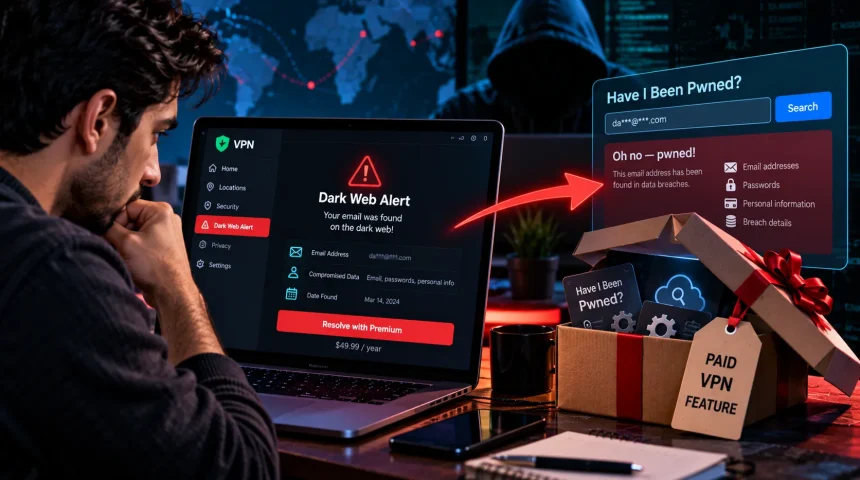
Most VPN dark web monitoring features cross-reference your email address against compiled databases of credentials leaked in known breaches, the same data that free tools like Have I Been Pwned access. They don’t actively patrol criminal forums or monitor real-time criminal activity. NordVPN’s Dark Web Monitor, for example, directly integrates with Have I Been Pwned. Free tools including HIBP, Firefox Monitor, Google’s dark web report, and Apple’s Password Monitor provide equivalent alerts at no additional cost. Where paid tiers genuinely add value: SSN and credit card monitoring, identity theft insurance, and remediation support.
What Dark Web Monitoring Actually Is
Let’s start with what’s happening under the hood.
When you sign up for a VPN’s dark web monitoring feature, you typically enter your email address. The service then cross-references that address against a massive compiled database of credentials from publicly disclosed data breaches. When your email appears in a new batch of breach data added to the database, you get an alert.
That process is useful. But it’s not surveillance of criminal forums. It’s not real-time detection. It’s a lookup against breach records that are usually months or years old by the time they’re compiled and searchable, the same records multiple free services already access.
The scale of data in these databases is genuinely alarming. CRIF’s Cyber Observatory found 2.5 billion unique records circulating on the dark web in H1 2026 alone. That’s the pool these monitoring services are searching. The question is whether you need to pay a VPN provider to search it for you.
The Free Tools That Do the Same Thing
Have I Been Pwned (HIBP), haveibeenpwned.com, is the benchmark. Built by security researcher Troy Hunt and backed by substantial corporate partnerships, it checks your email addresses against the largest publicly available breach database. It sends free notification emails when your address appears in new breaches. HIBP even has a notification feature that emails you within hours of new breach data being added. NordVPN’s Dark Web Monitor has been confirmed to integrate with HIBP’s data as its underlying source directly. If HIBP is free and your VPN’s dark web monitor uses HIBP’s data, you’re paying your VPN for the convenience of seeing that same alert inside the VPN app.
Google’s dark web report, available inside Google Account’s Security Checkup at myaccount.google.com, monitors your Gmail address, phone number, and other information you configure, and alerts you when they appear in breach data. Free for anyone with a Google account.
Firefox Monitor / Mozilla Monitor monitor.mozilla.org offers breach email monitoring and has expanded to include automatic removal requests to data broker sites for paid subscribers. The basic email monitoring is free.
Apple’s Password Monitor, built into iOS 14+ and macOS Big Sur+, automatically compares your saved Safari passwords against breach databases and alerts you within Settings when any are found in known breaches. Free with every Apple device.
Between these four tools, any consumer can cover their email addresses, phone number, and passwords across all major breach databases without paying a single additional dollar beyond what they already pay Apple or Google for a device or account.
What VPN Dark Web Monitoring Gets You That Free Tools Don’t
This is where it gets more nuanced. Free tools are excellent at monitoring email addresses and passwords. Premium paid services can cover more.
NordVPN’s standard Dark Web Monitor watches your registered NordVPN email address. Its Pro tier adds monitoring for phone numbers, credit card numbers, and national ID numbers. Its Coveron identity theft service (Prime plan) adds credit monitoring, identity theft insurance, and restoration support.
Surfshark Alert, available on the One plan, monitors email addresses, credit cards, and personal IDs.
ExpressVPN’s Identity Defender (higher tiers) covers SSN, exposed financial accounts, and personal details.
The genuine upgrade in paid tiers isn’t the dark web monitoring itself; it’s everything around it: insurance, credit freeze assistance, and human-assisted recovery if fraud actually occurs. NordVPN reported finding 8.4 million compromised accounts in a 90-day monitoring window in 2026. If one of those accounts is yours, and someone used your SSN to open a credit line, the alert alone isn’t enough. The recovery support is.
The Tier Hierarchy Worth Understanding
There are really four distinct levels of dark web monitoring, and understanding which one you’re buying matters:
Level 1: Free breach database alerts. HIBP, Google, Firefox Monitor, Apple. Email-focused. Reactive. Valuable. Costs nothing.
Level 2: VPN-bundled monitoring. NordVPN Dark Web Monitor, Surfshark Alert (basic). Identical to Level 1 in underlying data, but packaged inside the VPN app. Marginally more convenient. Not worth upgrading your plan specifically for this if you already use the free tools.
Level 3: Consumer identity protection. Aura, LifeLock, CoverOn, Identity Defender at their higher tiers. Monitors SSN, credit cards, financial accounts, real estate records. Includes credit monitoring across all three bureaus, identity theft insurance ($1M-$3M typically), and fraud recovery support. This is genuinely different from a free tool. It’s worth the money if identity fraud is a concern for you or your family, especially if your SSN has appeared in a breach.
Level 4: Professional dark web intelligence. KELA, Recorded Future, Cybersixgill, Q6 Cyber. These monitor criminal forums, Telegram channels, invite-only marketplaces, and emerging threat-actor discussions in real time. They don’t search breach databases. They watch where stolen data is created and sold before it ever reaches a compiled breach database. This is what powers Nasdaq Verafin’s fraud intelligence service for banks and enterprise security operations. It’s for businesses, not consumers, and costs significantly more.
The gap between Level 2 and Level 4 is massive, and most VPN marketing language blurs it deliberately.
How This Plays Out With Real Breaches
The timing problem is the most important thing to understand about breach database monitoring at any tier.
When the Substack breach exposed 663,000 user credentials, BreachForums posted the data in February 2026, before Substack’s own systems flagged the incident. But the time between a breach and that data being compiled into the databases consumer monitoring tools search can still be weeks or months.
Professional dark web intelligence tools might catch a Substack listing as it appears on BreachForums. A consumer monitoring tool will catch it when Have I Been Pwned adds the Substack breach to its database, which is still faster than waiting for the company to tell you. Free tools and Level 2 VPN features are roughly equivalent on this timeline.
Professional enterprise monitoring shows that the real early-warning gap is between when data is stolen and when it reaches any public breach database. That gap is where criminal forums, Telegram channels, and invite-only marketplaces operate. Consumer tools of any kind can’t see into those spaces.
What You Should Actually Do
For most people, the right move is simple. Set up Have I Been Pwned notifications for every email address you care about. Enable Google’s dark web report for your Gmail. Turn on Apple’s Password Monitor if you use an iPhone or Mac. These three steps together cost nothing and cover the same breach database ground as any VPN’s basic dark web monitoring feature.
If you’ve had your SSN or financial details appear in a breach, or if you’re managing digital security for a family, Level 3 identity protection services from Aura, LifeLock, or through your VPN’s top tier are worth evaluating specifically for the insurance and credit monitoring, not the dark web alerts.
For understanding what to do when your data is already circulating, our complete guide on dark web data exposure responses walks through the steps that matter, regardless of which monitoring service you use.
And if someone ever tells you their VPN has real-time dark web monitoring that actively patrols criminal forums, ask them which criminal forums, specifically. The honest answer is rarely one you can charge $15 a month for.
Frequently Asked Questions
Does NordVPN’s Dark Web Monitor use Have I Been Pwned data?
Yes. NordVPN has confirmed its Dark Web Monitor integrates with HIBP’s breach data. This makes the core function equivalent to HIBP’s free notification service.
What do the free tools miss that paid services provide?
Free tools monitor email addresses against breach databases. Higher-tier paid services add SSN monitoring, credit card monitoring, national ID monitoring, credit bureau reporting, identity theft insurance, and fraud recovery assistance.
Is there such a thing as real-time dark web monitoring for consumers?
No. Consumer monitoring services search breach databases compiled from past incidents. Real-time criminal forum monitoring is an enterprise intelligence service used by banks, security firms, and large organizations, not a consumer product.
Should I pay extra for my VPN’s dark web alert feature?
Not specifically for the dark web alert. If you’re considering upgrading to a higher VPN tier, evaluate whether you want the other features (identity insurance, credit monitoring, SSN alerts) that come with it. For breach notification, free tools provide equivalent coverage.