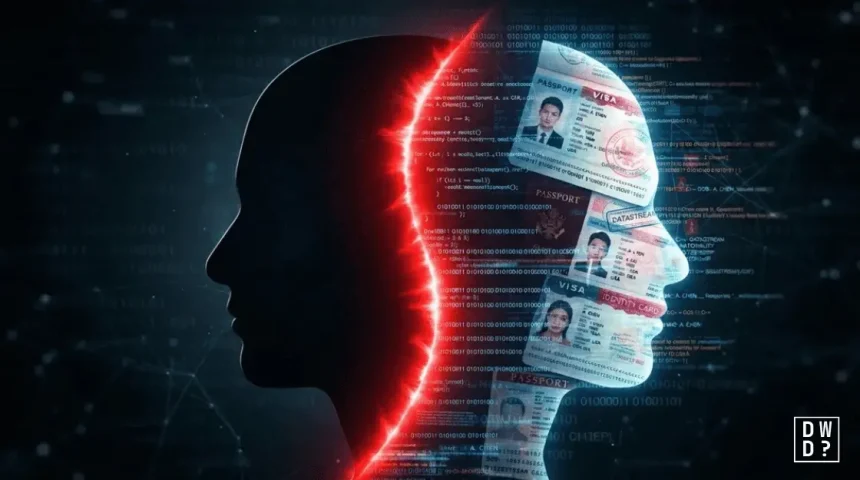
Identity theft and the dark web have an intertwined relationship that has fueled how cybercriminals exploit data in this modern era. The dark web is a hidden part of the internet that acts as an underground forum for illegal activities, including the sale of personal information like SSNs, names, phone numbers, email addresses and many more.
Cybercriminals utilise this medium for trading personal identifiers due to the anonymity the network offers. As of 2026, the scale of data theft and cyberattacks has grown significantly across the dark web, with millions of people falling victim to fraud and financial loss. In its most recent full-year figures, the Federal Trade Commission logged more than 1.1 million identity theft reports and $12.5 billion in reported fraud losses. Hence, every internet user needs to understand the connection between the dark web and identity theft.
In this article, “Identity Theft and the Dark Web”, we will be covering everything you need to know regarding how your data can end up on the Dark Web. We will also cover how stolen identities are obtained and sold, as well as how you can monitor your identities to prevent identity theft, and the necessary steps required to recover stolen data. Without further delay, let’s explore and uncover the necessary information.
What Is the Dark Web?
The Dark Web is a hidden part of the internet that is not indexed by traditional search engines like Google or Bing. Rather, it requires specialised software, like Tor, to access. The Dark Web is often associated with illegal activities, and our 2026 dark web statistics roundup puts roughly 60% of dark web sites, marketplaces and forums in the illicit category — with leaked data alone accounting for around 28% of all dark web content.
Furthermore, it is worth noting that the dark web is a subset of the deep web, a distinction our guide to the deep web versus the dark web breaks down in full. Cybercriminals use this space to sell stolen data, which includes credit card details, Social Security Numbers, login credentials, email addresses, social media accounts, and medical records. Other potential documents on the dark web include passports, driver’s licenses, and any other sensitive information.
Due to the anonymity the dark web offers, this layer of the internet has become a major forum for hackers, cyberattackers, and criminals. It is a space where illegal marketplaces and merchandise (such as weapons) can be found and purchased. Threat actors use the space to commit fraud, identity theft, and financial crimes. The frequency of identity theft on the dark web has become a massive black market business. That said, plenty of what circulates about this space is exaggerated — our breakdowns of the dark web iceberg and so-called red rooms separate the documented risks from the folklore, and who created the dark web explains why the anonymity layer exists in the first place.
What is Identity Theft?
Identity theft is a criminal activity that involves the use of someone else’s personal information without their permission to commit fraud or other illegal activities. It involves information such as Social Security number, bank account number, credit card information, driver’s licenses and passports.
Identity theft can result in various forms of fraud, including accessing personal accounts, opening up new accounts without your permission, making unauthorized transactions, or committing crimes. Victims of identity theft are mostly left with damaged credit, incorrect information added to their records, or wrongful arrest. Fraudsters can also use your number to receive medical, disability, and other benefits, which is why the Social Security Administration treats a misused SSN as a distinct category of harm.
How Does Your Data End Up on the Dark Web?
Identity theft happens when personal information is exposed through weak data security, lost devices, and even through deceptive communications. However, in many cases, cybercriminals obtain information through a data breach rather than through direct interaction with the victim. Once your data is compromised, finding its way to the dark web is very fast and easy, even before the victim realises anything is wrong. Here are some of the most common methods that cybercriminals can use to steal your personal information and sell it on the Dark Web:
- One of the most frequent methods is by means of an online data breach. This includes data breaches that involve a massive amount of information being accessed and taken, such as social security numbers and other private information, from companies’ databases by hackers. They then trade in the stolen information on the dark web because of its anonymity. The T-Mobile breach is a textbook example, putting roughly 76 million people’s Social Security numbers and driver’s license details into circulation.
- Another way information can be exposed on the dark web is via phishing attacks: When attackers attempt to get someone to disclose personal data via a fake email, message or seemingly legitimate website. From then on, they have used their credentials to commit financial fraud or some other illegal activity on the dark web. The Coinbase text scam and the fake Zoom call campaign run by North Korean operators show how convincing these lures have become.
- Weak Passwords and Credential Stuffing: A lot of people have been victims of identity theft as a result of being weak in their password and login details. People often use the same ID and password for different accounts, making them susceptible to credential stuffing. This means if a password is compromised on one site, and then used on many other sites, automated programs, called bots, can test a huge list of stolen passwords and usernames on any number of sites. It enables them to take advantage of stolen passwords to hack into different accounts. Verizon’s 2025 Data Breach Investigations Report found stolen credentials were a factor in 22% of all analyzed breaches.
- Malware and Keyloggers: Cybercriminals may send you a link or attachment disguised as a legitimate one you must click to get. Once you click, an infostealer or keylogger installs quietly and harvests saved browser passwords, session cookies and anything you type — then ships it off in bulk to be sold as “logs” on the dark web. IBM’s X-Force 2025 Threat Intelligence Index recorded an 84% weekly increase in infostealers delivered via phishing. A related variant is ransomware, where the attacker encrypts your files and demands payment — and publishes the data on a dark web leak site when the victim does not pay. Malware development itself has industrialised: VoidLink, an 88,000-line framework built largely by an AI agent, and criminal LLMs like FraudGPT and WormGPT are the clearest signs of where this is heading.
- Human error: Sensitive information can be exposed as a result of human mistake. For instance, if a staff member accidentally uploads a file on the shared server that doesn’t have the proper security measures in place, customers’ sensitive data may be stored there.
- Insider threats: Internal employees or those with access to the sensitive data could be responsible for stealing the information, selling it in illegal online forums which can lead to trafficking on the dark web. The Synergy incident is a useful case study in how quickly an alleged internal compromise becomes a marketplace listing.
- Joining a public hotspot/Wifi: At times, users’ information is stolen by fraudsters by using public WiFi. For instance, if you use an unsecured and unprotected public WiFi connection, the bad guy can try to crack into your network, and load your device with malware. Then, they can have access to your private information and sell it to the dark web.
How Stolen Information Is Transferred And Bought on The Dark Web?
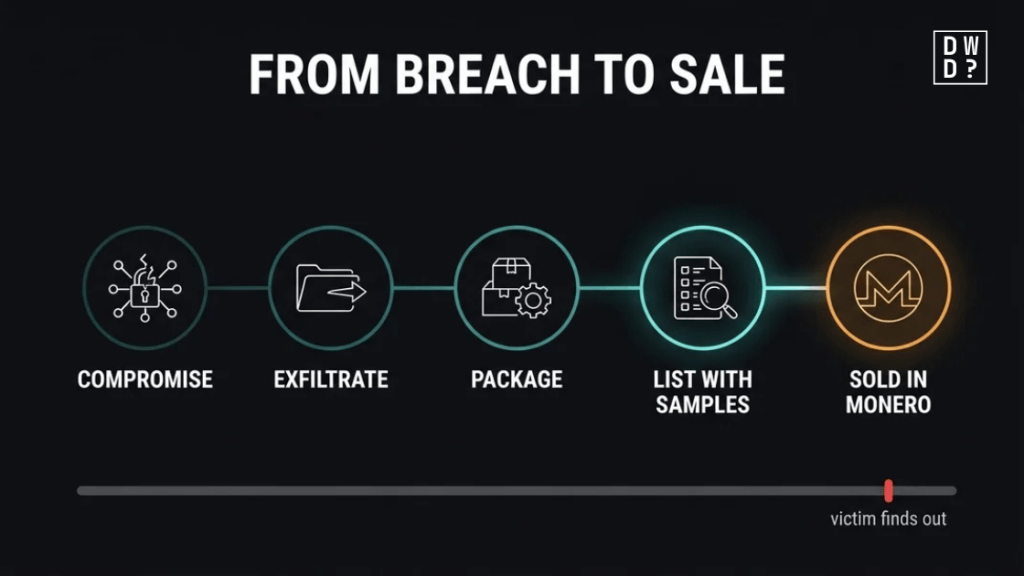
Stolen information rarely stays idle after a data breach. After a major breach, most attackers expose the compromised data on the dark web through a multi-stage supply chain that will take it from the initial theft to dark forums or marketplaces.
The process starts by compromising data using techniques such as phishing, exploiting software vulnerabilities or by means of malware. After exploiting the data, it is then packaged and placed on sale on various dark web forums and chat rooms.
Sellers come up with posts that outline the data and generally include samples as proof. Those who are interested in the stolen credential proceed to purchasing it. Payment is usually made in cryptocurrency. Bitcoin dominated the early years, but its public ledger made transactions traceable by firms like Chainalysis, so markets have migrated to privacy coins — over 60% of dark web transactions now settle in Monero.
Identity Theft And The Dark Web: Real Pricing
Most of the activity on the dark web is driven by cybercriminals, who engage in various activities, from stealing and selling data to offering cybercrime-as-a-service. Among these services, the prominent one is the selling of stolen data. In this section, we will be looking at the real prices of some stolen credentials on the dark web.
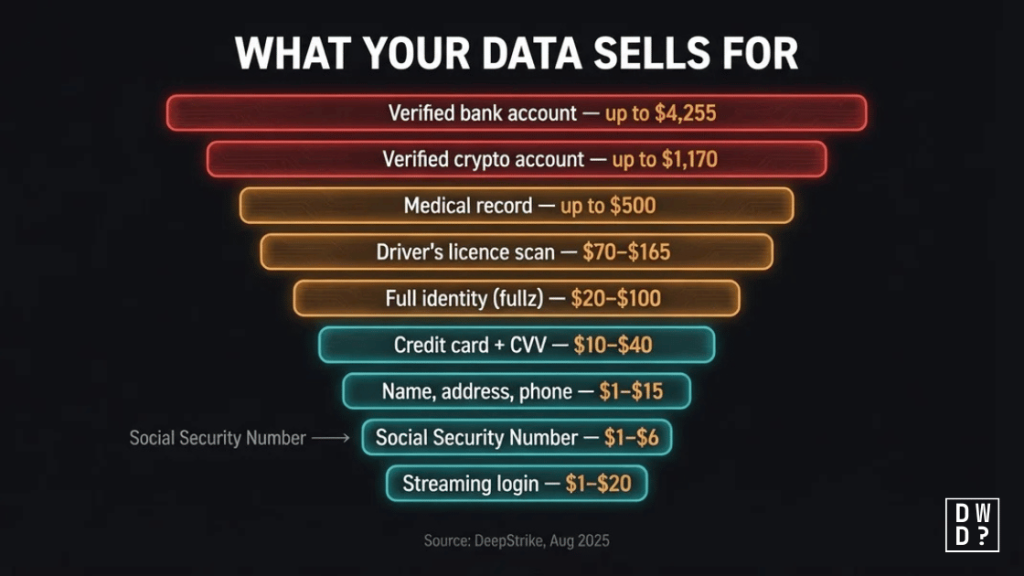
Prices below are consolidated from DeepStrike’s August 2025 dark web pricing survey and the Privacy Affairs Dark Web Price Index, whose last published edition is 2023. Treat them as a snapshot, not a fixed rate card — freshness, account balance, completeness and seller reputation move every one of these numbers.
| Item | Price |
|---|---|
| Social Security Numbers (SSNs) | $1 – $6 |
| Fullz (US, Name/SSN/DOB) | $20 – $100+ |
| Credit Card details (US, with CVV) | $10 – $40 (cards with a verified $5,000+ limit fetch ~$110 – $120) |
| Online Bank Login | $200 – $1,000+ (depends heavily on balance) |
| Full Bank account details (verified, high-balance) | $1,800 – $4,255 |
| Coinbase Verified Account | $120 – $250 |
| Personal information and documents (phone numbers, IDs, names, address, etc) | $1 – $15 |
| Kraken Verified Account (KYC High) | Up to ~$1,170 |
| Gmail Account | ~$60 – $65 |
| Social media Account (Facebook, Instagram, Twitter/X, etc) | $20 – $50 |
| Driver’s License (scan) | $70 – $165 |
| Passport (scan) | $50 – $100 |
| Medical Record (complete) | Up to $500+ |
| Infostealer Malware Subscription | ~$1,024 |
| DDoS Attack Service (Unprotected site, 24 hours) | ~$35 – $45 |
| Crypto exchange account details | $150 – $2,650 |
| Cash App verified account | ~$850 |
| Streaming service login credentials | $1 – $20 |
| PayPal account details | $10 – $30 (no or low balance) |
One thing worth noting: physical forged documents sit in a completely different price bracket from scans. A scanned US passport goes for around $50 – $100, while a physical forged EU passport has been listed at $3,000 – $4,000.
How To Protect Your Data From Identity Theft
Well there’s nothing anyone can do to erase their details from the dark web once it’s been stolen and compromised. However, there are necessary steps to take to safeguard your information and lower the chances of it ending up in the wrong hands. These steps include:
Use strong passwords: Use complex, unique passwords for each account. Also avoid reusing passwords across multiple accounts. It makes it easier for hackers to access multiple accounts once they’ve stolen your credentials. Using a password manager can help you generate and store secure passwords.
Enable two-factor authentication (2FA) or multifactor authentication (MFA): Activate 2FA or MFA on all accounts where possible. This adds an extra layer of security by requiring a second form of identification, such as a text code or authentication app, before granting access to your account. Where a service supports it, phishing-resistant FIDO2/WebAuthn keys are stronger than SMS codes, which can be intercepted through SIM swapping.
Keep software updated: Install the latest security patches for your operating system, applications, and devices. Hackers often exploit vulnerabilities in outdated software versions to steal data.
Use encryption: Encrypt your data on computers and mobile devices so that, even if the device is stolen or compromised, the data remains unreadable without the proper decryption keys.
Proper email management: Use different email addresses for different purposes (e.g., personal, work, online accounts) to limit the risk of hacking and data theft. Also, be cautious of phishing attacks – avoid opening suspicious emails or links.
Monitor data breaches: Use a free service like Have I Been Pwned to check whether your email address, phone number or passwords have appeared in a known breach. Note that HIBP works from breach corpora and does not cover Social Security numbers — for SSN and credit-file coverage you need a paid monitoring service. Our reviews of Aura and Norton compare what each actually scans, and our full monitoring section covers the rest.
Be careful when sharing information online: Try to reduce how much personal information you share, especially when you post on social media or fill out online forms.
Avoid entering sensitive information on public Wi-Fi networks: If you must use a free public wifi, ensure you are connected through a trusted virtual private network (VPN) to encrypt your data.
Install antivirus software and keep it updated. Avoid downloading files from unknown sources and avoid clicking on suspicious links or attachments. It is also a good practice to verify the legitness of website URLs before initiating any downloads.
Regularly monitor financial accounts. Make it a regular practice to check your bank and credit card statements to catch unauthorized charges early.
Steps to Take if You Are a Victim of Identity Theft
If you realized that you’ve become a victim of identity theft, follow these steps to immediately mitigate the damage and restore your identity:
Report the Incident: Report the identity theft to the Federal Trade Commission at identitytheft.gov, which generates a personal recovery plan and an official Identity Theft Report. File a report with your local police as well if you know the thief, if they used your identity in a police encounter, or if a creditor asks for one.
Notify Financial Institutions: Notify your financial institutions that you are in danger of fraudulent withdrawals or transactions and ask them to place a stop on the accounts or close the accounts.
Notify the credit bureaus: Place a fraud alert on your credit reports. You only need to contact one of the three major bureaus — Equifax, Experian or TransUnion — and that bureau is legally required to notify the other two. A credit freeze is stronger than a fraud alert, but it must be placed with all three bureaus separately.
Update passwords and PINs: Ensure that all online accounts such as banking, email and social media are all protected by other passwords and PINs to ensure that no further access is allowed.
Notify Other Organizations: Report the identity theft to other organizations or entities that might be involved, including utility companies, healthcare providers and government agencies. If your SSN was used on a fraudulent tax return, the IRS has a dedicated process for that.
Take Extra Precautions: Do any other actions that apply to your identity and accounts (e.g. watch for your Social Security number being used).
Watch Financial Accounts: Keep a close watch on your financial accounts, credit reports and on other sensitive information for any additional suspicious movement. You are entitled to free weekly credit reports from all three bureaus at AnnualCreditReport.com.
Conclusion
Selling of stolen data is one of the prominent activities, among many other illegal activities on the dark web. Roughly 60% of dark web sites and forums are engaged in illicit activity of some kind, and leaked data makes up around 28% of dark web content on its own — more than drugs and weapons combined. Once your data hits the dark web, it’s nearly impossible to recover it. Infact, most times, these data are purchased and later used to access the victim’s personal information to commit fraud or other criminal activities through identity theft.
Identity theft can severely damage an individual’s creditworthiness. It can leave the victim with bills he/she did not incur and cannot pay. Therefore, it is very important for not just internet users, but everyone to regularly monitor and track their information on the dark web.
While you can’t undo a data breach or fully recover stolen data, there are proactive measures to take after discovering a breach in order to take control of what happens next with your data. These include monitoring your accounts and changing passwords as quickly as possible. In addition, affected individuals can also report the identity theft to the right agencies. Our data breach reports and scam alert database track new incidents as they surface.
Frequently Asked Questions (FAQs)
Can I remove my information from the dark web after a data breach?
No. Once your information is exposed on the dark web, it becomes almost impossible to fully remove it. That’s because stolen data is quickly sold, shared and stored across multiple anonymous platforms. However, what you can control is how much damage the exposure causes. So after exposure, monitor your credit, place security freezes, change compromised credentials, and work with identity protection services to manage the potential threat. Be sceptical of any service promising to delete your data from the dark web — that is not technically possible.
What do I do if my information is found on the dark web?
If you discover that your information is on the dark web, the first thing to do is identify the compromised data. Afterwards, place a fraud alert on your credit reports. You can also freeze your credit to prevent new accounts from being opened in your name.
Among the compromised data, if your login credentials are part, it’s best to update your passwords immediately and turn on MFA or 2FA for extra protection. Afterwards, contact your financial service provider such as your bank or credit card account, so they can help secure your account or issue new credentials.
What is the price of stolen data on the dark web?
Well, not all personal information is valued the same. Some data cost more, depending on the type or kind of data. Also, the prices of stolen data can vary based on demand and how complete the data is. A standalone SSN can go for as little as $1, while a complete medical record can fetch $500 or more — see the pricing table above for the current spread.
How do I know if my data is on the dark web?
Most people discover that their data has been exposed on the dark web only after experiencing fraud, such as a credit card charge, a filed loan application, or an account created with their identities. Other times, especially if it’s a large breach involving an organisation, the company alerts its customers of the potential breach.
However, the most reliable way to know if your data has been leaked on the dark web is to proactively and continuously monitor the web. This is possible with legitimate data breach trackers. These tools scan dark web sources and breach corpora for your email addresses, phone number and other personal identifiers; the paid tiers also cover Social Security numbers and credit-file activity. If matched, it alerts you of the compromised data. Our monitoring reviews cover which services check what.