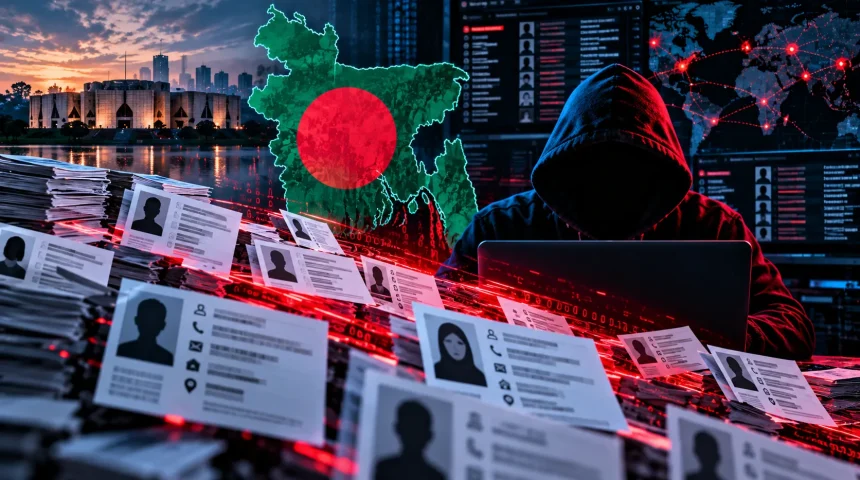
CyberStation (Brain Station 23 PLC) scanned 767 domains across 15 sectors and found more than 1.8 million user records linked to Bangladesh on the dark web, along with at least 17,362 live login credential sets. Government services had the largest share of exposed citizen records. Technology and telecommunications had the highest exposure rates. CyberStation says figures are conservative and actual exposure may be greater. No specific breach source was confirmed; the data likely comes from multiple third-party breaches over time.
What the Scan Actually Covered
CyberStation didn’t examine a single leaked database. It conducted a methodical sweep of 767 domains across 15 different sectors, essentially mapping how much Bangladesh-linked data was visible in dark web marketplaces, forums, and data dumps.
The scan covered sectors like government services, banking, telecommunications, technology, education, and more. Exposed records were found in almost all 767 domains, which points to a widespread issue, not just a single event. When nearly every domain shows signs of exposure, it means there is an ongoing pattern of data leaks from many sources over time.
Government services had the most exposed citizen records. This is especially worrying in Bangladesh, where digital government services have grown quickly, including e-government portals and National ID (NID) verification used in banking, mobile financial services, and official applications. If someone’s NID details, contact information, and login credentials are leaked, it makes it easier for identity fraud to happen across many platforms at once.
Technology and telecommunications had the highest rates of data exposure, with more domains in these sectors showing problems. In Bangladesh, where mobile internet use has grown fast and services like bKash and Nagad serve millions, data leaks in telecom can lead to serious financial risks.
The Login Credentials Are the Most Urgent Detail
The 1.8 million user records are a big concern. However, the 17,362 active login credentials are especially important because they pose a different and more direct threat.
Attackers use user records, names, addresses, phone numbers, and ID numbers for targeted fraud, phishing, and impersonation. This is serious. But login credentials are even more dangerous. If attackers have a working username and password, they can log into accounts directly without needing to trick anyone.
In Bangladesh, one login credential can unlock government portals, online banking, or mobile financial service accounts. If a login is compromised, it is not just personal data at risk. Attackers could access money, government records, or other information that could be misused later.
This connects to a pattern we’ve seen globally in 2026: CRIF Cyber Observatory data shows email-and-password combinations appear in 95.9% of dark web credential records, and exposed credentials can appear on criminal forums within 24 hours of a breach. The 17,362 figure from CyberStation covers only what was verifiably identified; the actual pool of exposed Bangladeshi credentials in circulation is almost certainly larger.
Why the Government Sector Exposure Is the Critical Finding
The fact that government services have the most exposed citizen records should be a key topic in policy discussions.
Bangladesh’s digital government has grown quickly. The a2i (Aspire to Innovate) program from the ICT Division has helped digitize many citizen services. NID-linked verification is now used for opening bank accounts, registering mobile SIMs, accessing government benefits, and more. Since the NID is the main form of identity, if its data leaks, it can damage trust in all services that rely on it.
Bangladesh has faced major data incidents before. In 2023, a database from the Registration of Birth and Death service reportedly exposed millions of citizen records. Another report found that the Office of the Registrar General Birth & Death Registration (BDRIS) left personal data open through a weakly secured API. The new CyberStation findings show that data from these incidents can keep circulating long after the first leak.
This pattern mirrors what we’ve covered on how South Asian digital infrastructure becomes a target: rapid digital expansion, combined with cybersecurity frameworks that haven’t scaled at the same pace, creates a gap that criminal actors consistently exploit.
What CyberStation Said About the Solutions
Muhibbul Muktadir Tanim, Head of Cybersecurity Services at CyberStation, summed up the core challenge directly. “We cannot address risks that we cannot see. Our goal is to help organizations understand what information has been exposed and act before cybercriminals can misuse it.”
MJ Ferdous, Executive Director of Brain Station 23, emphasized that Bangladesh should rely less on foreign software and develop its own cybersecurity skills. This is important for both economic strength and security independence. Using foreign platforms for government digital systems creates risks that go beyond just data exposure.
Tanvir Hassan Zoha, a cybersecurity analyst at the event, said it is important to raise awareness and work together on prevention strategies. The panel talked mainly about the risks of dark web data exposure and how to deal with them.
The event’s language reflects a shift in how Bangladeshi cybersecurity professionals frame the problem, not as isolated incidents to react to, but as an ongoing intelligence and monitoring challenge. This framing aligns with the global dark web intelligence market, where proactive monitoring has moved from optional to essential for organizations handling citizen data at scale.
Why the Real Numbers Are Probably Larger
CyberStation called the 1.8 million figure a “conservative estimate.” This is a common way for companies to be careful when sharing findings, but it also shows how dark web data scanning works in real life.
Scanning 767 domains across 15 sectors gives you a snapshot of what’s publicly or semi-publicly visible. The dark web also includes private channels, invitation-only forums, and encrypted Telegram groups where data circulates without monitoring tools indexing it. What CyberStation found represents the visible surface of Bangladesh’s dark web data exposure, not its full extent.
This pattern matches what researchers have found globally; early warning signals on dark web forums often reflect only the most recently traded or publicly advertised portion of a larger circulating dataset. Data that was breached years ago may be quietly traded in private channels for months or years before appearing in a public listing.
What Bangladeshis Should Do Right Now
If you use any Bangladeshi government digital services, banking platforms, or mobile financial services like bKash or Nagad, take these practical steps now.
Change the passwords on your most important accounts and avoid using the same password for different services. Reusing passwords is the main reason one leak can lead to many account hacks. If you can, use a password manager.
Enable two-step verification on mobile banking and government portal accounts wherever the option exists. Even if a password is compromised, two-factor authentication adds a barrier that stops most credential-based attacks.
Be careful with calls, SMS messages, or emails that mention your personal details. Scammers with leaked Bangladeshi data will use real information to make their messages seem trustworthy. Just because someone knows your NID number or address does not mean they are from a real institution.
Report any suspected fraud or data misuse to BGD e-GOV CIRT, Bangladesh’s national Computer Incident Response Team, at cirt.gov.bd or via their public contact channels.
For a broader checklist on what to do when your personal data has been exposed, our dark web data exposure guide covers response steps that apply regardless of where the breach originated.
Frequently Asked Questions
How many Bangladeshi records were found on the dark web?
More than 1.8 million user records (18 lakh), along with at least 17,362 sets of active login credentials, according to CyberStation’s scan of 767 domains across 15 sectors.
Which sectors had the most exposure?
Government services had the largest share of exposed citizen records. Technology and telecommunications had the highest data exposure rates.
Is this a new breach?
Not necessarily a single new breach. CyberStation’s findings reflect data accumulated over time from multiple third-party breaches. No single confirmed source is identified.
What are login credentials specifically?
Username-and-password combinations that let attackers access accounts directly, more dangerous than standard personal data records because they give attackers live system access without social engineering.
Who conducted this research?
CyberStation, the cybersecurity division of Brain Station 23 PLC, a Bangladeshi IT company.